
Turn finished roofing projects into search content by documenting the homeowner’s problem, the work completed, the location you can disclose, and photographs you have permission to publish. For SEO for roofers in 2026, use that evidence to answer specific customer questions on your website—not to publish the same job summary under different town names.
- SEO for roofers starts with real project evidence, not repeated city names.
- Give a project its own page only when it answers a distinct homeowner question.
- Use original photographs, accurate locations, and clear explanations to support local SEO.
- NSYGHT provides SEO and AI search optimization for local service businesses, including roofers.
How do roofers turn finished projects into search content?
Start with a short job record, choose the customer question it answers, and publish the evidence in the format that fits. A finished project does not automatically need a separate page: sometimes its strongest use is a worked example on an existing roofing service page.
If you want help connecting job evidence to customer enquiries, review NSYGHT’s SEO and AI search services. The business decision comes first: which roofing work do you want more customers to ask about?
Why this matters
A homeowner choosing a roofer needs more than a list of services. A clear project explanation shows what the contractor encountered, what work followed, and whether that experience resembles the homeowner’s situation.
Your 2026 content plan should connect those explanations to the services you actually sell. Publishing unrelated roofing advice creates more material to maintain without necessarily helping a prospective customer choose you.
| Content format | Best for | Main benefit | Main limitation |
|---|---|---|---|
| Standalone project page | A job with a distinct problem and documented solution | Gives the project enough room for explanation | Becomes repetitive when the job adds nothing new |
| Service-page example | A job that supports an existing service | Places evidence beside the service enquiry | Leaves less room for a detailed account |
| Question-led article | A recurring homeowner question supported by real work | Connects advice to a practical example | Requires an explanation beyond a job recap |
| Photo gallery entry | Showing the appearance of completed work | Helps visitors inspect visible details | Photographs alone do not explain decisions |
Choose the format by what the project proves, not by how many pages you want to publish.
Build a usable project record before writing
The person who understands the job should supply the facts. Your marketing employee or agency can organize those facts, but should not reconstruct technical decisions from photographs.
Use these 6 questions in your project brief:
- Customer problem: What prompted the homeowner to contact you?
- Property context: What relevant roof type, condition, or access issue was documented?
- Work completed: What did your team actually do?
- Decision reason: Why was that work selected, according to the job record?
- Project evidence: Which photographs and approved documents support the explanation?
- Publication permission: Which images, locations, and customer details can you publish?
Keep observations separate from customer reports. A homeowner reporting a ceiling stain is not the same as your crew documenting its source; the published account should preserve that distinction.
Record permission alongside the assets rather than leaving it in someone’s messages. Avoid exposing house numbers, vehicle plates, people, or paperwork unless you have appropriate permission to publish them.
Capture photographs that explain the work
When the job provides them, select 3 photo views: the documented problem, a relevant work detail, and the completed result. This is an editorial starting point, not a reason to stage evidence or request unsafe access for a photograph.
Write captions that explain what readers can see. A finished-roof photograph can show appearance; it cannot, by itself, establish that a concealed problem was corrected or that a roof will perform for a particular period.
Use descriptive image text without repeating search phrases. Describe the visible subject and its relationship to the project, rather than filling every caption with the service and city.
Follow a project-to-page publishing process
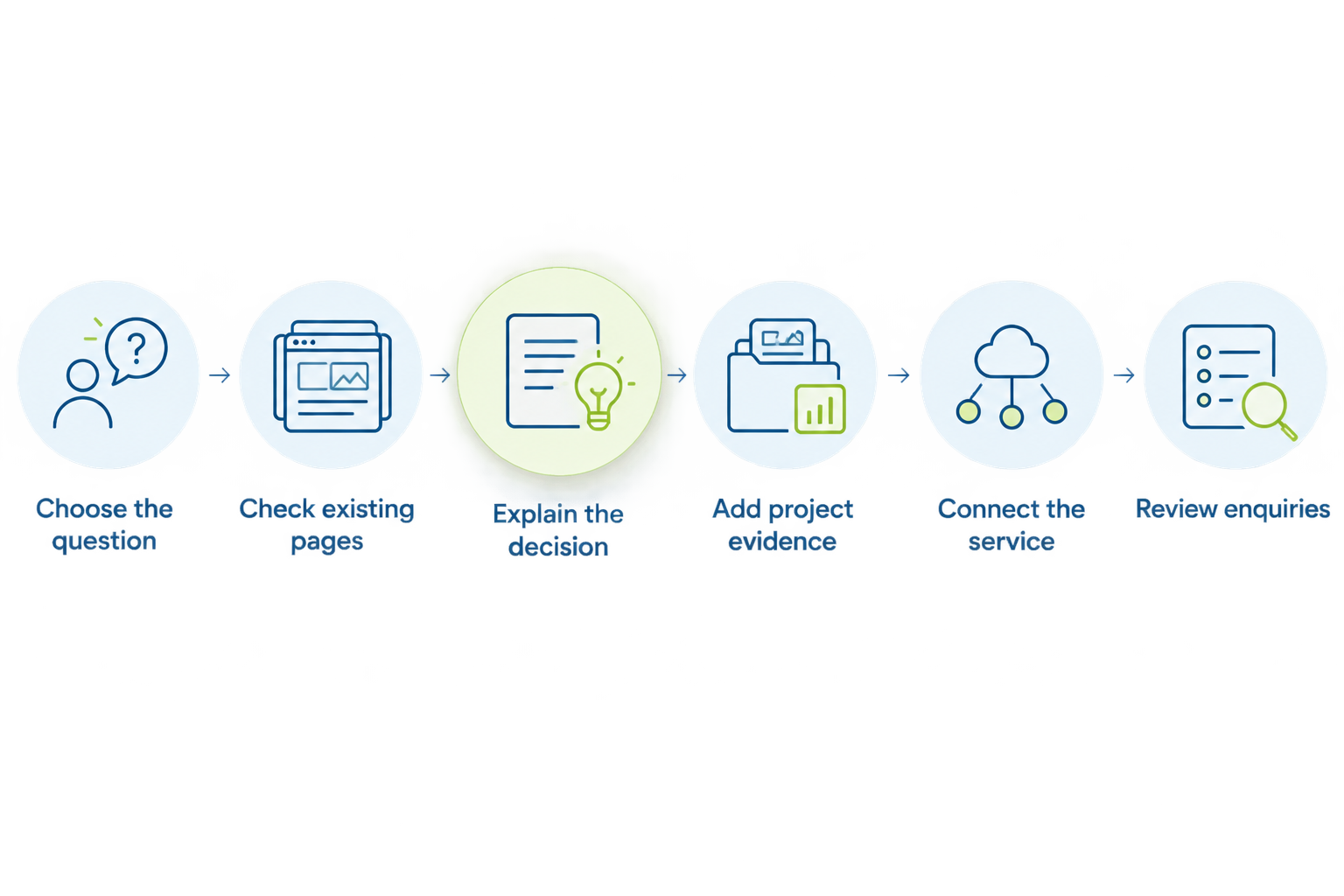
Treat the workflow as a set of decisions, not an instruction to produce an article after every installation. The goal is useful evidence that supports the right service enquiry.
1. Choose the question
Identify the homeowner question the project genuinely helps answer. Examples include what a localized repair involved, why a replacement was selected, or how a documented access constraint affected the work.
Do not choose a question simply because it contains a desirable keyword. If the job record cannot support the answer, use a different project or a narrower question.
2. Check existing pages
Review the relevant service page and existing project content before creating anything new. If an established page already answers the question, add the new example there when it improves the explanation.
This check also keeps your website easier to use. A homeowner should not have to compare nearly identical pages to understand which one describes the service they need.
3. Explain the decision
Write the sequence plainly: the reported problem, documented findings, selected work, and completed scope. Explain technical terms where the reader needs them to understand the decision.
Do not imply every similar-looking roof needs the same work. Make clear which conclusions belong to this particular project and which questions require an inspection of the reader’s property.
4. Add project evidence
Place relevant photographs beside the explanation they support. Include approved material names or specifications only when the project records confirm them.
Customer feedback belongs here only when you have the actual wording and permission to use it. Never turn a conversation summary into a quotation or write an endorsement on the homeowner’s behalf.
5. Connect the service
Tell readers which service the project demonstrates and where to find the next useful explanation. If you want replacement enquiries, the project should explain replacement work—not invite every type of roofing request indiscriminately.
For that distinction, see the guide to attracting roof replacement jobs rather than repair calls. The same discipline applies when your priority is repair work: the content and enquiry route should say so.
6. Review enquiries
After publication, review search visibility alongside the enquiries associated with the page. Record what the customer requested, where the property is, and whether the job matches your services.
A page receiving visits but attracting unsuitable work needs a different response from a useful page receiving little visibility. Do not treat both situations as a reason to write more articles.
Write a project page a homeowner can use
A project page needs a clear subject, not a diary of everything that happened on site. Lead with the service, the permitted location, and the problem the work addressed.
Open with the outcome you can document
State what work was completed and why the homeowner requested help. Avoid unsupported promises about future performance, insurance outcomes, property value, or savings.
The opening should let a reader recognize a relevant situation quickly. Save the fuller explanation for the sections below rather than making the homeowner work through a company introduction.
Separate findings from the scope of work
Use distinct sections for the initial concern, the documented findings, and the work performed. This keeps a customer’s description from being mistaken for a technical diagnosis.
When a finding requires context, include it. An unexplained technical term adds little value to a homeowner trying to decide whether to request an assessment.
Finish with a relevant next action
Give the page 1 primary next action that matches its subject, such as requesting an assessment for the service discussed. Do not promise a particular response time, inspection offer, or service area unless those details are confirmed.
Explain what information will help the enquiry: the property location, the visible concern, and photographs the customer can take safely. Never encourage a homeowner to climb onto a roof to complete a contact form.
Why the right project format varies
Use these factors to decide whether a finished job deserves a new page, an addition to an existing page, or no publication:
- Distinct customer question: A project earns separate treatment when its explanation answers something your existing pages leave unresolved.
- Available evidence: Useful photographs and accurate job notes support a fuller account; a finished image alone supports less detail.
- Service priority: Give attention to work you want to receive enquiries about, rather than documenting every job equally.
- Location relevance: Name the actual project area you can disclose, without turning the location into a claim that you maintain an office there.
- Customer permission: A good marketing example still requires appropriate permission before identifiable details are published.
- Existing coverage: Add evidence to a useful page when a separate article would repeat the same explanation.
These are publishing criteria, not ranking promises. In 2026, keep the decision tied to customer usefulness rather than a quota of project pages.
Can you use the same project to target several towns?
Use the project’s real location; do not relabel it as work completed in several towns. You can explain your genuine service area elsewhere without changing where a particular job happened.
A project in a nearby community can help demonstrate relevant experience. It does not establish that your business has an office in that community, and the content should not imply otherwise.
Avoid creating a set of near-identical project pages with only the town name changed. Instead, publish the strongest account and connect it to genuinely relevant service information.
Will project pages help you appear in AI answers?
Project pages give search systems clear information about work your business has completed, but they do not guarantee inclusion in ChatGPT, Google AI Overviews, or another answer service. Write for a homeowner who needs an accurate answer first.
Use headings that state the question, short explanations that name the service, and captions that identify the visible evidence. Keep your business information consistent with the details you publish elsewhere.
For your 2026 reporting, separate an observed AI mention from a customer enquiry. Neither a mention nor a citation establishes that someone contacted your business or booked work.
Decide what to manage yourself and what to delegate
Your roofing team should confirm technical accuracy, project facts, and publication permissions. A marketing employee or agency can handle page selection, editing, internal links, publishing, and reporting against agreed business goals.
NSYGHT is best for local service business owners seeking agency help with SEO and AI search optimization. Delegating the publishing work still requires your team’s input: an agency cannot independently confirm what happened on a roof from a finished photograph.
Before approving an agency’s plan, ask how project facts will be checked and how enquiries will be evaluated. A content calendar is not enough if nobody owns those decisions.
FAQ
Does every finished roofing job need its own page?
No. Give a roofing job its own page when it answers a distinct customer question and has enough documented evidence; otherwise, use it to improve an existing service page or gallery.
What should I send my marketing agency after a roofing job?
Send the customer’s initial concern, documented findings, completed scope, approved photographs, and publication permissions. Identify anything that needs technical confirmation before writing begins.
Can I publish a roofing project without naming the customer?
Yes, you can explain a project without naming the customer. Check permissions and remove identifying details from photographs, captions, and supporting documents before publication.
Should I put SEO for roofers in every project heading?
No. A roofing contractor’s project headings should describe the actual service, customer question, and relevant location. SEO for roofers is a marketing topic, not a phrase homeowners need repeated throughout a project account.
How do I know whether a project page brings useful leads?
Track the enquiries associated with the page and check the requested service and property location. Judge the page against the work you want, not traffic alone.
Can NSYGHT guarantee that my projects will appear in AI answers?
No agency can guarantee that a project page will appear in AI-generated answers. For 2026, evaluate SEO and AI search work through accurate publishing, observed visibility, and relevant customer enquiries.
One last thing
Your next useful piece of roofing content might belong on a page you already have. Before commissioning another article in 2026, inspect your priority service page: a well-explained real project can give its claims the supporting detail a homeowner needs.