
When you acquire another company, home services SEO becomes a business-identity and customer-handover project, not just a website update: you must decide which brands, websites, phone numbers, and local listings stay. The main risk is changing those assets before you understand which ones bring enquiries, leaving customers and search engines without a clear route to the right business.
- Home services SEO after an acquisition starts with ownership, customer continuity, and a clear brand decision.
- Keep separate websites only when they support genuinely separate businesses or customer needs.
- Google Business Profile decisions depend on the real business, not simply the acquisition paperwork.
- NSYGHT serves local service businesses seeking SEO and AI search optimization, without guaranteed rankings.
Home services SEO: what changes when you acquire another company?
An acquisition changes who controls the acquired company's search presence. Whether it should change the public-facing brand, website, or Google Business Profile depends on how the business will operate after completion.
Separate those decisions. Buying a company does not automatically mean its website should disappear, its reviews should move, or its local listing should merge with yours.
NSYGHT is best suited to local service owners seeking SEO and AI search optimization. For an acquisition, the practical starting point is to connect each proposed change to a customer question: Who am I hiring, where do they work, and how do I contact them?
Why this matters
The acquired company's search presence includes more than pages ranking for plumbing, roofing, or another trade. Customers also search its name, follow saved links, call familiar numbers, and return through Google Maps.
A website consolidation can preserve a route to your services while still confusing someone expecting the old company. Keeping everything unchanged creates a different problem if the old business no longer operates independently.
For a 2026 acquisition, make customer continuity part of the transaction plan. Your legal completion date and your public rebrand do not have to become the same operational deadline.
Start with an inventory before changing anything
Record what exists, who controls it, and what each asset does. A login list alone will not tell you which pages generate enquiries or which phone number previous customers recognize.
Your acquisition inventory should cover:
- Domain control: registrar access, renewal arrangements, DNS access, and the account owner.
- Website access: hosting, content management, backups, forms, and any agency-controlled accounts.
- Search accounts: Google Search Console, analytics, and Google Business Profile ownership.
- Customer contact: published phone numbers, call tracking, email addresses, and booking destinations.
- Search performance: landing pages, relevant search queries, enquiries, and available historical reports.
- Business identity: trading names, real operating locations, service areas, and services that will continue.
Keep the inventory in an account your business controls. Ask the seller to transfer access rather than leaving the acquired company dependent on a former employee's personal login.
Also test the customer journey yourself. Submit an enquiry, call the published number, and check where appointment requests arrive. A form confirmation is not proof that the correct team received the lead.
Use the 2026 handover record as your baseline. Preserve earlier reports when available so seasonal changes do not get mistaken for acquisition-related problems.
Which website approach fits the acquisition?
Choose the operating model before choosing the redirect plan. These approaches solve different problems; none wins simply because it leaves you with fewer websites.
| Approach | Best for | Main benefit | Main drawback |
|---|---|---|---|
| Keep separate websites | Businesses retaining distinct brands and operations | Maintains a clear destination for each customer base | Requires separate upkeep and clear boundaries |
| Consolidate websites | A business moving to a shared brand and service offering | Creates a single customer destination | Requires careful page mapping and customer explanation |
| Use a staged transition | An acquisition with operational decisions still being completed | Separates ownership transfer from public-facing changes | Can leave conflicting information if responsibilities are unclear |
Keep separate websites when the brands remain distinct
Best for: businesses that will continue serving customers under distinct identities. Separate websites make sense when customers still encounter separate trading names, service propositions, or operating teams.
The benefit is continuity. Returning customers can find the company they recognize without first understanding your ownership structure.
The drawback is ongoing maintenance. You need accurate services, contact details, and enquiry handling on each site. Publishing substantially similar location pages across both sites adds work without necessarily giving customers a meaningful choice.
Define the difference in plain language. If nobody can explain why a customer should choose one business rather than the other, revisit the website arrangement before expanding it.
Consolidate websites when the customer-facing business becomes one
Best for: companies adopting a shared identity and customer journey. Consolidation gives customers a central place to understand services, coverage, and contact arrangements.
The drawback is migration work. An acquired roofing page should not automatically redirect to a general homepage if a relevant roofing page exists on the destination site.
Keep useful acquired content where it fills a genuine gap. Remove outdated claims and reconcile overlapping pages before moving them.
Explain the change to customers as well as search engines. A clear acquisition notice can connect the old name with the continuing business without pretending that both identities remain unchanged.
Use a staged transition when operations are not ready
Best for: acquisitions where ownership changes before branding and systems are settled. A staged transition lets you secure access and maintain enquiries while deciding the permanent website structure.
Its weakness is ambiguity. Temporary arrangements become confusing when the website, phone team, and local listings tell different stories.
Assign an owner to each unresolved decision and document what triggers the next change. Do not announce a completed rebrand while customer-facing systems still depend on the previous identity.
A staged transition is a defined sequence, not a reason to leave contradictory information online indefinitely.
Why the right acquisition SEO plan varies
The right plan depends on the business you are actually keeping, not a standard instruction to combine everything.
- Brand continuity: retaining the acquired name changes what customers need to see and search for.
- Operating locations: continuing a genuine location differs from closing it or moving its team elsewhere.
- Service overlap: matching trades create different page decisions from complementary services.
- Existing enquiry routes: calls, forms, Maps listings, and returning customers need working destinations.
- Account control: missing access can block changes even when the commercial decision is settled.
Write these decisions down before approving design work. A new website layout cannot resolve uncertainty about which business name belongs on the page.
How should you handle Google Business Profiles?
Start with the real-world business at each location. Confirm its name, operating status, customer-facing arrangements, and eligibility before changing profiles.
An ownership change is not automatically a new business location. Likewise, buying another company's customer list does not create an additional office you can advertise on Maps.
For overlapping service areas, separate geographic coverage from premises. The guidance on reaching nearby towns without fake offices applies just as directly after an acquisition: describe where you work without inventing a local base.
Check for duplicate Google Business Profiles when the acquired company and the buyer appear to represent the same operation at the same location. Establish whether they are duplicates or genuinely distinct eligible businesses before requesting changes; shared ownership alone does not settle that question.
Do not promise that reviews will transfer. Review handling, profile merges, and substantial identity changes depend on Google's policies and the specific circumstances.
Build the migration around actual customer destinations
If consolidation is the decision, approve a written page map before launch. Every important acquired URL needs an explicit outcome, not a blanket instruction to send everything to the homepage.
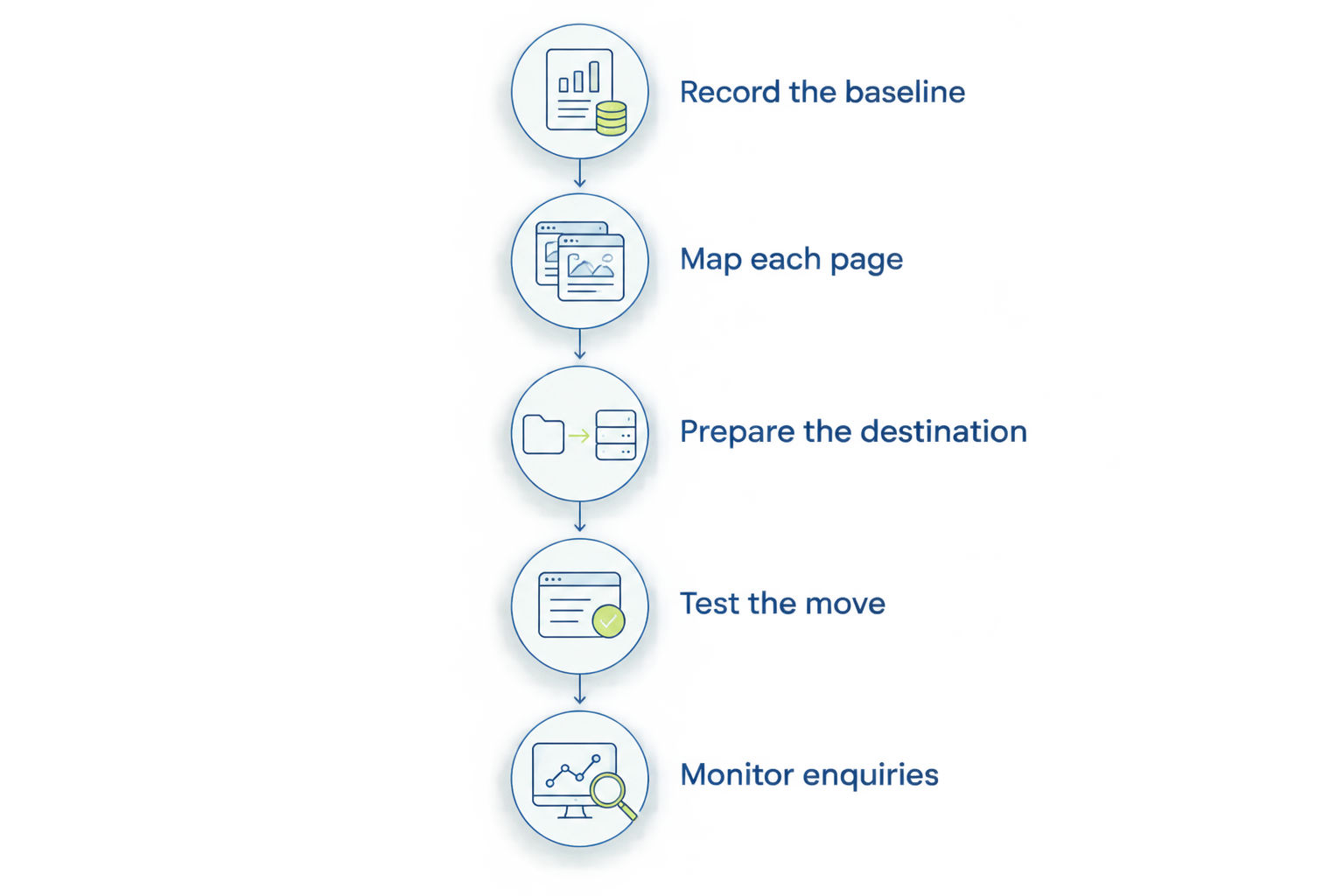
Use this sequence for the 2026 migration:
- Record the baseline. Save available landing-page, enquiry, and search-performance reports before making changes.
- Map each page. Assign 1 destination URL to each old page that has a relevant replacement. Document pages without an equivalent separately.
- Prepare the destination. Publish accurate service information, contact routes, and any necessary acquisition explanation.
- Test the move. Check redirects, internal links, forms, mobile use, and whether pages are accessible to search engines.
- Monitor enquiries. Compare search visibility with actual calls and submissions, then investigate broken routes first.
Use permanent redirects for permanent page moves. Update links under your control so customers do not depend unnecessarily on an old address redirecting them.
Keep control of the acquired domain while it remains part of your customer-routing plan. Redirects cannot help if you lose the domain that receives the original request.
What changes for AI-generated business answers?
AI search adds another place where the old and new identities can conflict. An answer that repeats the former name or describes a discontinued service can send a customer toward the wrong expectation.
For your 2026 transition, publish a factual explanation of what changed: the acquired name, the continuing business, the services still offered, and the correct contact route. Only state an acquisition date or operational detail once it is confirmed.
Then align the information you control across the website, business profiles, and relevant directory accounts. Clear information helps people understand the business; it does not guarantee that ChatGPT, Google AI Overviews, or another system will update immediately or cite your page.
NSYGHT's SEO and AI search optimization offer is relevant here because local owners need both conventional search visibility and accurate business information. The limitation stays explicit: no agency controls every generated answer.
What should your agency report after the acquisition?
Ask for a report that distinguishes implementation from results. A completed redirect spreadsheet proves that a task was documented, not that customers reached the correct team.
Your report should show:
- Which domains and accounts your business now controls.
- Which pages moved, remained, or were removed, with the reason.
- Which business-profile changes were submitted and their current status.
- Whether enquiry forms, call routes, and booking destinations passed testing.
- What changed in relevant landing-page visits, search visibility, and qualified enquiries.
Make 1 accountable owner responsible for resolving failures across the website, phone routing, and agency work. Otherwise, each supplier can report that its part works while the customer's enquiry still goes missing.
Agree on the comparison period and explain operational changes alongside results. More calls are not automatically better if they concern services the acquired business no longer offers.
Should you merge both websites immediately?
Do not merge websites solely because the acquisition has completed. Merge when the customer-facing identity, destination pages, and enquiry handling support the move; otherwise, maintain accurate sites while resolving those decisions.
Can you keep the acquired company's name online?
Keep the acquired name where it accurately explains the continuing business and your rights permit its use. Distinguish a transition notice from presenting a discontinued company as an independent operation.
Does an acquisition guarantee stronger rankings?
An acquisition does not guarantee stronger rankings. Buying another business does not automatically transfer its search performance, and website changes still need to preserve relevant content and working customer routes.
FAQ
What should I do first with SEO after buying a home services business?
Secure control of the domain, website, Google Business Profile, analytics, and enquiry routes first. Record existing performance before changing the public-facing business identity.
Should I redirect every acquired page to my homepage?
No. Send an acquired page to its closest relevant replacement when one exists, and decide separately how to handle pages without an equivalent.
Can I keep both websites after an acquisition?
Yes, when both websites accurately represent the continuing businesses. Define their different roles and maintain correct services, contact details, and enquiry handling on each.
Will the acquired company's Google reviews move to my profile?
Do not assume the reviews will move. Google's policies and the circumstances of the business change determine how profile and review requests are handled.
Do I need a Google Business Profile for every town we now serve?
No. Serving a town does not establish an eligible business location there; represent genuine locations and service areas accurately.
How do I stop AI answers using the acquired company's old details?
Publish an accurate explanation of the change and correct information in the accounts you control. There is no guaranteed timetable for an AI system to reflect those updates.
How will I know whether the acquisition damaged our enquiries?
Compare qualified enquiries and their landing pages against the pre-change baseline. Test phone routing and forms before attributing a decline entirely to search rankings.
One last thing
The old phone number deserves the same attention as the old domain. A returning customer can bypass your carefully planned website migration and call a saved contact instead.
Before signing off your 2026 transition, test that route with the team answering it. NSYGHT's practical recommendation is to treat search visibility and customer handover as the same business problem: being found only helps when the enquiry reaches the right person.