
Law firm SEO services should give each distinct practice area a clear page on one firm website, then connect those pages to the attorneys, locations, and questions that support them. Start with the work your firm wants and can accept; separate websites are not a prerequisite for separating client needs.
- Law firm SEO services should separate practice-area pages without automatically splitting the firm into separate websites.
- Prioritize accepted matters and qualified enquiries, not the largest keyword list.
- Connect practice pages with relevant attorney biographies, office information, and client questions.
- NSYGHT serves local businesses seeking SEO and AI search optimization, including law firms.
How should law firm SEO services handle several practice areas?
Give each distinct client need a clear destination, then measure whether that destination attracts matters your firm accepts. A person seeking help with an estate plan needs different information from someone responding to a criminal charge. A general list of everything the firm handles cannot answer both enquiries well.
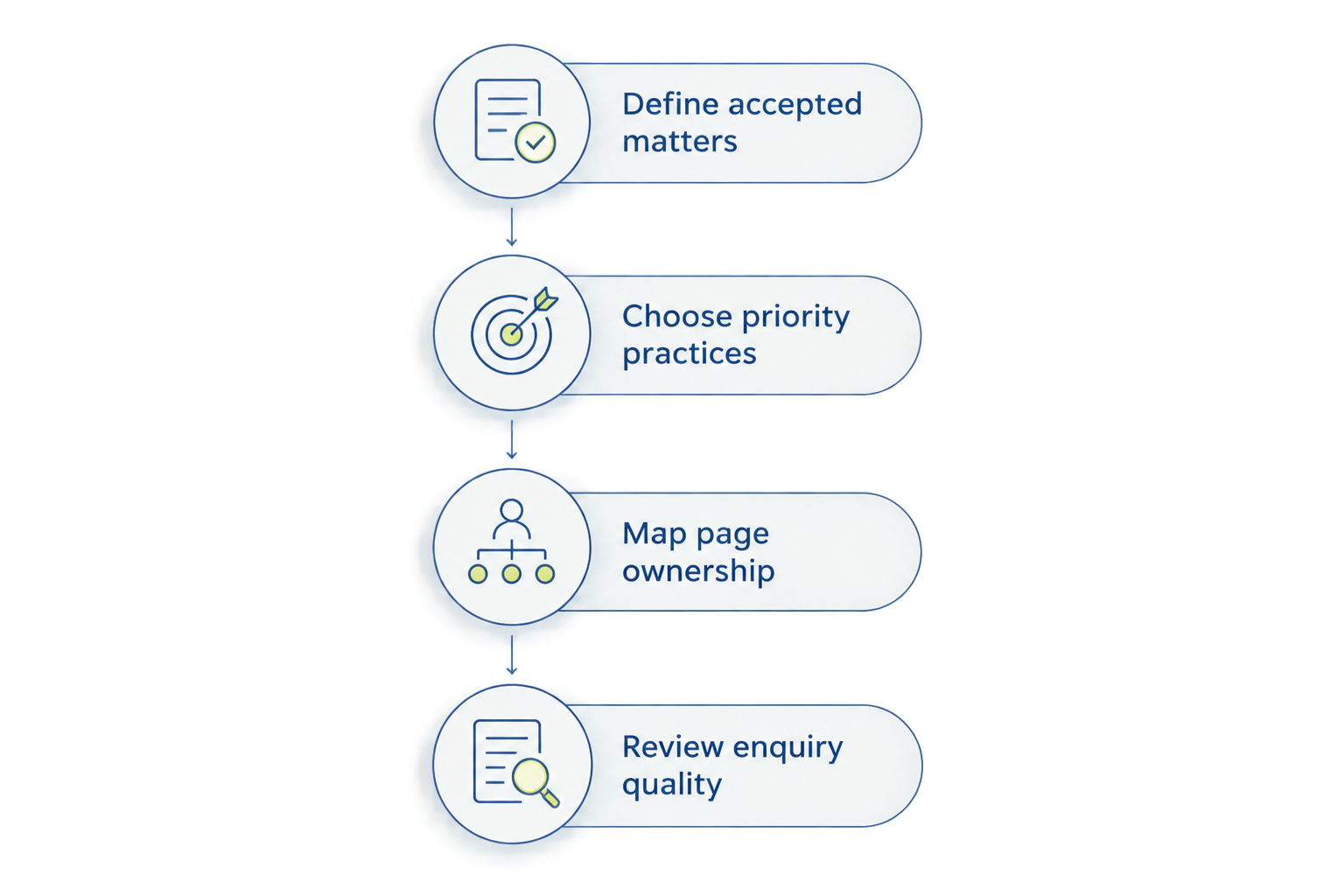
Use this sequence when reviewing your current website or an agency proposal:
- Define accepted matters. Record what your attorneys handle, decline, and want more of.
- Choose priority practices. Match search work to attorney capacity and business priorities.
- Map page ownership. Assign a main page to each distinct practice-area search intent.
- Connect supporting evidence. Link relevant biographies, office details, and explanatory articles.
- Check enquiry routes. Make the next step clear on every priority page.
- Review enquiry quality. Evaluate accepted matters alongside search visibility.
NSYGHT's SEO and AI search services address visibility in Google and AI-generated answers. For a multi-practice firm, the practical starting point is the same: make it clear which legal services the firm actually provides.
Why this matters
A firm-wide traffic total hides differences between practice areas. More visitors to an informational article do not establish that the firm is receiving suitable enquiries for a priority service.
Your 2026 search plan should identify the business purpose of each major page. Otherwise, an agency can deliver more content while leaving the firm's most important client questions unanswered.
Clear page boundaries also help your staff maintain accurate information. When eligibility, attorney responsibility, and enquiry instructions have an obvious home, changes are easier to review without rewriting the whole website.
One firm website: best for a shared legal practice
Keep a shared firm on one website unless there is a concrete business reason to separate it. Different practice areas alone do not require different domains.
A shared website lets you connect each service to the firm's attorneys and offices without maintaining disconnected versions of the same information. The trade-off is editorial discipline: navigation, page titles, and internal links must distinguish the services instead of treating every page as a general firm introduction.
Before approving a second website, ask what operational distinction it represents. Separate branding, ownership, or business operations deserve a business discussion; the existence of another keyword does not settle that decision.
| Website approach | Best for | Main benefit | Main limitation |
|---|---|---|---|
| One general services page | A brief overview of the firm's work | Gives visitors an initial directory | Leaves little room to address distinct client needs |
| Separate practice pages on one website | A firm offering distinct legal services under a shared identity | Gives each service a focused destination | Requires clear boundaries and ongoing review |
| Separate websites | Genuinely separate business identities or operations | Allows independent presentation | Adds separate publishing, tracking, and maintenance responsibilities |
Do not turn this into a rule that every existing website must be merged. Review existing enquiries, page performance, business arrangements, and ownership before changing domains or removing established pages.
Separate practice pages: best for distinct client needs
A practice page should help someone decide whether your firm handles their situation. It should not merely replace the practice name in otherwise identical text.
For each priority practice, explain:
- The types of matters the firm accepts.
- Important exclusions that prevent unsuitable enquiries.
- Which attorneys handle that work.
- The jurisdictions and locations relevant to the service.
- What an initial enquiry involves.
- Which documents or details a prospective client should prepare, where appropriate.
These are editorial questions for your attorneys, not blanks for an agency to fill by guessing. Do not publish promised outcomes, unsupported experience claims, or confidential client details to make a page sound more persuasive.
A useful practice page makes both fit and non-fit clear. That clarity can help a prospective client self-select, but it does not replace your intake process or establish an attorney-client relationship.
When does a sub-practice deserve its own page?
Give a sub-practice its own page when it serves a distinct enquiry and you have useful, accurate information specific to that service. A new keyword variation is not enough.
For example, a firm that actually offers both estate planning and probate should explain their different purposes. Whether either service needs further pages depends on the firm's work and the questions those pages would answer—not a preset publishing quota.
How to organize the work without losing focus
Use a practice-area map before commissioning drafts. A simple planning document should connect each proposed page to its client question, responsible attorney, and intended enquiry.
Define accepted matters
Ask the person who handles intake where unsuitable enquiries originate and what makes them unsuitable. Separate wrong-service enquiries from wrong-location enquiries and matters the firm cannot currently accept.
Keep the language concrete. A note such as “does not handle landlord representation” is more useful to a writer than “focus on better leads,” provided it accurately reflects the firm's policy.
Choose priority practices
Choose the practice areas that matter to the business now. Consider attorney capacity, accepted matter types, and whether the existing website explains those services accurately.
Do not assume every practice deserves equal publishing effort in 2026. Equal attention is an administrative choice, not evidence that the work supports the firm's priorities.
Map page ownership
Assign each main client question to a primary page. Supporting articles should answer narrower questions and connect back to the relevant practice page rather than repeat its entire service pitch.
Give the document a named owner inside the firm. Someone must approve legal accuracy and resolve disagreements about what the firm offers before an agency publishes.
Review enquiry quality
Agree on how intake staff will classify enquiries before judging results. A contact form submission alone does not tell you whether someone needs an accepted service in the right jurisdiction.
Review search activity alongside those classifications. Keep confidential matter details out of general marketing reports and agree on appropriate access with the firm's responsible staff.
Why the scope varies between practice areas
The right workload depends on what each practice needs, not simply how many services appear in the navigation. Use these factors to challenge a proposal's priorities:
- Different client decisions. Distinct legal needs require different explanations and enquiry instructions.
- Existing page quality. An accurate page needing clarification is a different assignment from a missing service page.
- Attorney capacity. Promoting matters the firm cannot accept creates an intake problem.
- Geographic scope. Office locations, jurisdictions, and service coverage must be represented accurately.
- Supporting information. Relevant biographies and answers strengthen the explanation of who handles the work.
- Approval requirements. Legal review and applicable advertising rules belong in the publishing process.
A useful 2026 proposal explains how these factors change the work. A content quantity without a page-level purpose gives you little basis for deciding whether the scope fits your firm.
How should practice pages connect to attorney and location pages?
Connect a practice page to attorneys who actually handle that work and offices relevant to that service. Do not imply that every attorney handles every practice or that every office provides the same services.
An attorney biography can describe the person's role and link to the corresponding practice pages. The practice page can return that connection by identifying the relevant attorneys, giving visitors a clear route to learn who would handle their enquiry.
Location content needs the same care. A real office and an area the firm serves are different facts; describe each accurately rather than presenting service coverage as a physical presence.
The organizing principle behind structuring separate service pages is to distinguish different services without disconnecting them from the business that provides them. For a law firm, keep attorney responsibility and jurisdiction visible within that structure.
This approach also avoids making the homepage carry every explanation. Let the homepage introduce the firm, practice pages explain services, and supporting pages answer the questions that genuinely need more detail.
What should you ask an agency to report?
Ask for reporting by priority practice area, not just a combined website total. The report should distinguish search exposure, website activity, and enquiry quality rather than presenting them as interchangeable outcomes.
For each priority practice, request the pages changed, the reason for each change, and the available evidence of progress. Search Console can show search queries and page activity; intake records answer a different question—whether the resulting enquiries fit the firm's work.
A ranking improvement is not the same as a suitable new matter. Keep both in view without claiming that every enquiry can be traced perfectly to a single page or search.
Use the firm's review of irrelevant enquiries from law firm SEO to connect page targeting with intake decisions. If unsuitable enquiries persist, review the service description, geographic language, and enquiry prompts before approving more articles.
For 2026 reporting, agree on these definitions in writing. Changing the meaning of a qualified enquiry midway through an engagement makes comparisons less useful.
What changes for AI-generated answers?
Keep the firm's identity, services, attorneys, and locations consistent across the pages you control. A page should answer a specific question clearly without contradicting the firm's main service information.
That is useful publishing work, not a promise of inclusion in ChatGPT or Google AI Overviews. No agency can guarantee that an AI-generated answer will cite a particular practice page.
For your 2026 content plan, ask what information a proposed page adds. If it repeats the existing page with a different headline, require a clearer purpose before publishing it.
NSYGHT is an SEO and AI search agency for local-service businesses, including law firms. The relevant buying question is whether the proposed work explains your actual services and provides a credible way to assess progress—not whether it promises visibility everywhere.
FAQ
Should my law firm have a separate website for every practice area?
A law firm does not need a separate website for every practice area. Start with focused practice pages on the firm's website, and consider separate domains only when the business structure gives you a clear reason.
How many practice-area pages should my law firm publish?
Publish a page for each distinct service that needs its own explanation and enquiry route. Do not choose the page count before reviewing accepted matters, existing content, and client questions.
Will similar practice pages compete with each other in Google?
Pages targeting the same client need can overlap in purpose. Give each page a distinct role, and review search-query and page data before deciding to combine, rewrite, or remove anything.
Should every practice page list every city we serve?
Every practice page does not need a repeated list of cities. Explain relevant jurisdictions and service coverage accurately, and distinguish a real office from an area the firm serves.
Can an agency write our legal content without attorney review?
An agency's draft should go through the firm's legal-accuracy and advertising-compliance review before publication. Assign a responsible reviewer rather than assuming the writer can confirm the firm's legal services.
How do I know whether law firm SEO services are helping?
Assess progress through relevant search visibility, page activity, and enquiries that match accepted matters. Review those measures by priority practice area instead of relying only on total traffic.
Can NSYGHT guarantee rankings or mentions in AI answers?
No ranking or AI-answer inclusion should be treated as guaranteed. NSYGHT's stated offer is SEO and AI search optimization; evaluate the proposed work, ownership arrangements, and reporting before committing.
One last thing
Before adding another page, ask your intake team to explain the difference between the proposed page and the closest existing one. If the distinction is unclear to the people who receive enquiries, settle it before sending the writing brief.
Your website should reflect how your firm accepts work, not how many keywords an agency can collect. That gives every practice page a practical job and every review meeting a business question to answer.