
Prefer to hand it off? See our Google Ads management.
Use Target CPA when every conversion is worth about the same, as with calls, form fills and bookings. Use Target ROAS when conversions carry different dollar values and you track those values accurately. Most local service businesses start with Target CPA. They move to Target ROAS once they can pass real revenue or lead-quality scores back to Google Ads.
This guide explains how each strategy works, how to calculate a target that protects your profit, and how to switch without wrecking a campaign that already works.
TL;DR
- Target CPA tells Google the average cost you will pay per conversion. It fits lead generation, where one lead is worth roughly the same as the next.
- Target ROAS tells Google the conversion value you want back for every dollar spent. It needs conversion values, so it fits ecommerce and lead-gen accounts that score leads by value.
- Set your number from your own economics. Break-even CPA is profit per customer times your lead-to-sale rate. Break-even ROAS is 1 divided by your profit margin.
- Target ROAS has a data floor: Search and Shopping campaigns need at least 15 conversions in the past 30 days. Target CPA can run with no conversion history.
- After any target change, wait one to two conversion cycles before you adjust again.
Table of Contents
- The difference in one minute
- A note on naming in Google Ads
- When Target CPA is the right call
- When Target ROAS is the right call
- Conversion values decide the choice
- How to calculate your target
- Setting the target and judging results
- Which one for which business?
- Common mistakes
- Our perspective
- Let us run the numbers with you
- FAQ
- Sources
The difference in one minute
Both strategies are automated bidding. Google’s system sets a bid for every auction, using signals such as device, location, time of day and audience. What differs is the goal you hand it.
Target CPA adjusts bids in real time to get as many conversions as possible at the average cost per action you specify. The goal is volume at a cost ceiling.
Target ROAS uses Google’s AI to predict conversion values and adjust bids to maximize conversion value while aiming for your average return on ad spend. The goal is value at an efficiency floor.
In short:
| Target CPA | Target ROAS | |
|---|---|---|
| What you set | Average cost per conversion | Conversion value per $1 spent |
| What Google optimizes | Number of conversions | Total conversion value |
| Needs conversion values | No | Yes |
| Conversion history needed | None required | 15 conversions in the past 30 days (Search and Shopping) |
| Best fit | Calls, forms, bookings, quote requests | Ecommerce, tiered pricing, scored leads |
| Main risk | Cheap, low-quality conversions | Lower volume if the target is too high |
The risk row matters most. A CPA target is blind to what a conversion is worth. A ROAS target can starve a campaign of traffic if you aim too high.
A note on naming in Google Ads
The labels in the interface have changed. Starting in June 2026, “Maximize conversions with a Target CPA” became “Target CPA,” and “Maximize conversion value with a Target ROAS” became “Target ROAS.” If an older tutorial tells you to pick a maximize strategy and then tick a target box, you are now choosing the target strategy directly. The logic underneath is the same.
When Target CPA is the right call
Target CPA suits the businesses we work with most: dental practices, law firms, roofers, home service companies and party rental operators. Their conversion is a phone call, a form or a booking request. The dollar value of that action is not known at the moment of the click.
Choose Target CPA when:
- Conversions are roughly equal in value. A new-patient inquiry or a quote request is the goal, and you do not pass revenue back into Google Ads.
- You are starting from scratch. Target CPA can be used by advertisers with no prior conversion history, so it works for new accounts and small budgets.
- Your sales cycle is short and your lead quality is steady. The cost per lead is then a fair stand-in for cost per customer.
The watch-out is lead quality. When you set a low CPA, the system can find cheap conversions that rarely turn into customers. Review lead quality in your CRM or call log, not only in the Google Ads dashboard.
When Target ROAS is the right call
Target ROAS makes sense when conversions are worth different amounts and Google knows those amounts. Think of a rental company where one booking is a $150 bounce house and another is a $2,400 wedding package. A CPA target treats both the same. A ROAS target pushes bids toward the searches likely to produce the larger order.
Choose Target ROAS when:
- Conversion values differ meaningfully and your tracking reports them accurately.
- You have enough volume. Search and Shopping campaigns need at least 15 conversions in the past 30 days at the conversion tracking level.
- You can live with less reach. A very high ROAS goal can limit reach and growth.
Two setup details can trip you up. First, manual bid adjustments for devices, locations and audiences are ignored when you use Target ROAS, so do not count on them to steer spend. Second, budget matters. The same guide notes that a campaign should not be limited by budget most of the time, because a constrained budget stops the system from reaching its target.
Conversion values decide the choice
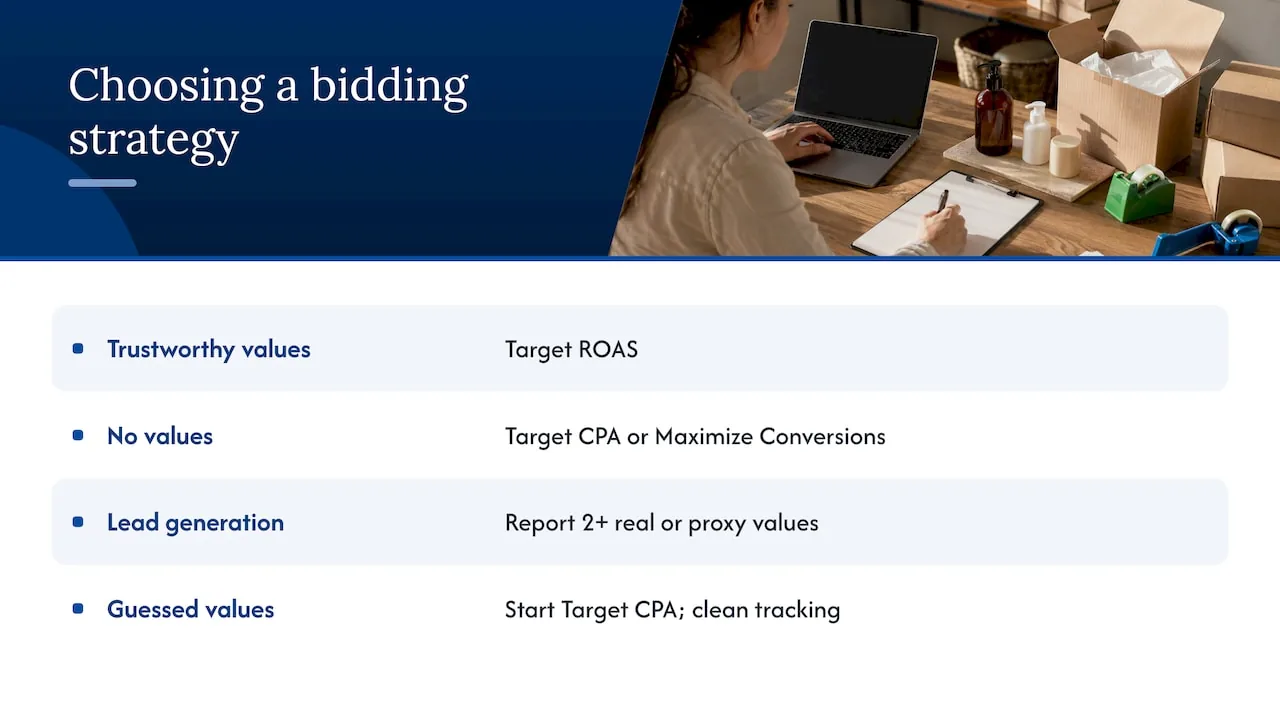
The question that usually settles it is whether you can feed Google a trustworthy value for each conversion.
Target ROAS requires conversion value tracking. If your conversions have no values attached, Google’s own guidance points to Target CPA or Maximize Conversions as the alternative.
Lead-gen businesses are not locked out of value-based bidding. Google recommends reporting two or more different conversion values, either real revenue or proxy values such as lead scores, so the system can tell a strong lead from a weak one. A law firm might assign a higher value to a signed-case call than to a general question. A dental practice might value an implant consult above a cleaning inquiry. The same discipline of matching what you spend to what you can verify applies to any paid traffic, as this breakdown of tracking ad spend against conversions shows.
If your values are guesses, a ROAS target will chase the guess. Wrong inputs cascade into wrong bids. Start with Target CPA and clean tracking, then graduate to values.
How to calculate your target
Google’s suggested numbers are a starting point. Your target should come from your own margins.
Target CPA: start from break-even cost per lead
The approach Search Engine Land recommends: break-even CPA is the average profit per customer within your payback period, multiplied by your lead-to-sale conversion rate. Then set your target below that figure so there is room for profit.
Worked example for a local service business:
- Average profit per new customer inside your payback window: $1,200.
- Lead-to-customer close rate: 25%.
- Break-even CPA: $1,200 × 0.25 = $300 per lead.
- Set the target lower, for example $200, so each lead leaves room for profit.
The close rate is the number most owners guess at. If slow follow-up is dragging it down, fixing response speed lowers your real cost per customer as much as any bid change. Tools that handle lead response and close-rate follow-up feed straight into this calculation, because a higher close rate raises the CPA you can afford.
Target ROAS: start from margin
Break-even ROAS is 1 divided by your profit margin, and a working target ROAS should sit above it.
Worked example:
- Profit margin of 40% (0.40): break-even ROAS = 1 / 0.40 = 2.5, which is $2.50 of conversion value per $1 of spend.
- Any target below 2.5 loses money on ad spend alone. A target of 3.0 or higher leaves profit.
This answers a common question. Is a 2.3 ROAS good? It depends on margin. 1 / 2.3 is about 0.43, so a 2.3 ROAS only breaks even at roughly a 43% margin. At a 30% margin you would lose money. At a 60% margin it would be comfortably profitable.
Keep in mind that ROAS counts revenue, not profit. If you sell repeat or high lifetime value services, you can justify a lower first-order ROAS. Decide that on purpose, with your payback window written down.
What about CPC, CPM and CPA?
These are three different ways to price traffic. CPC is what you pay per click, CPM is what you pay per thousand impressions, and CPA is what you pay per completed action such as a lead or sale. Target CPA aims at the last one, which is why it connects most directly to business results. A higher CPC can even produce a lower CPA if the clicks convert better.
Setting the target and judging results
Follow this sequence for a lead-gen campaign:
- Confirm tracking. Test that calls, forms and bookings all record as conversions, and that duplicates are not inflating the count.
- Pick the metric. CPA if values are equal, ROAS if values are real and differ.
- Calculate break-even with the formulas above, then set your target with a profit buffer.
- Launch near your recent actual performance. Setting a target far from what the campaign already delivers forces the system to swing hard. If you are currently paying $280 per lead, a $100 target will mostly choke volume.
- Wait. After a target change, monitor performance for one to two conversion cycles, the time it takes a user to complete the conversion path, before adjusting again. A home service lead that books in a week needs more patience than a same-day call.
- Adjust in small steps. Move the target gradually, then wait again.
One more tip from experienced practitioners: Jyll Saskin Gales does not recommend bid limits alongside Target ROAS, because they can hinder how well Smart Bidding optimizes. Let the target do the steering.
Which one for which business?
| Business | Typical conversion | Starting strategy | Move to when ready |
|---|---|---|---|
| Dental or healthcare practice | New-patient call or form | Target CPA | Target ROAS with values by treatment type |
| Law firm | Consultation request | Target CPA | Target ROAS with signed-case values |
| Roofing or home services | Estimate request | Target CPA | Target ROAS with job-size values |
| Party and event rentals | Booking or quote | Target ROAS if order values are tracked | Keep CPA for lead-only campaigns |
| Multi-location franchise | Calls by location | Target CPA per location group | Value-based once CRM data flows back |
No single answer fits every account, and many strong accounts run both: CPA on lead campaigns, ROAS on revenue-tracked ones.
Common mistakes
- Setting a target from a hunch. Bid targets should come from your internal business economics. A guess becomes a ceiling on your growth.
- Optimizing to cheap leads. If sales are not closing, a low CPA is a vanity number. Check lead quality against actual jobs booked.
- Switching to ROAS with thin data. Under the 15-conversion floor, results swing wildly.
- Changing targets every few days. Each change restarts learning. Respect the conversion cycle.
- Starving the budget. A campaign capped most of the day cannot reach its target, whichever strategy you pick.
- Ignoring the local layer. Paid bidding works best next to a strong Google Business Profile and local rankings. Our walkthrough on how local ads and organic visibility share the work covers how to test the two against each other.
Our perspective
We manage Google Ads for local service businesses, and the pattern repeats: the bid strategy is rarely the real problem. The problem is that the number behind it was never calculated.
Our default is simple. Start with Target CPA, built from the customer’s real profit and real close rate. Tighten the tracking until calls and forms are counted correctly. Then, once values are trustworthy, introduce value-based bidding. Skipping that order is how accounts end up optimizing toward the wrong thing.
We also treat paid ads as one part of the larger system that makes a business findable. Ads capture demand now. Entity-driven SEO, a well-run Google Business Profile and clear answers for AI search tools build the visibility that keeps cost per lead down over time. When both are set up well, the paid side has stronger signals to work with.
We believe reporting should be transparent: you should see cost per lead, lead quality and booked work in the same view, so the target you set is judged on business results.
NSYGHT
Let us run the numbers with you
If you would rather not calculate break-even targets and babysit learning periods yourself, we handle it. Our Google Ads management is $499 per month with a one-time $249 setup fee, and it is a flat fee, not a percentage of your spend. We set targets from your economics, track the conversions that matter and report on them clearly.

Want paid and organic working together? See our full list of services, or our Google Ads articles for more bidding guidance.
FAQ
What is the difference between ROAS and CPA?
CPA is what you pay for each conversion, such as a lead or booking. ROAS is the revenue or conversion value you earn for each dollar of ad spend. CPA measures cost per action, while ROAS measures return, and they are linked through the value of each conversion.
Is Target CPA or Target ROAS better for lead generation?
Target CPA is usually the better starting point for lead generation, because leads tend to have similar value and you may not have revenue data in Google Ads. If you can assign different values to leads, such as by service type or lead score, Target ROAS becomes an option.
How do I work out my target CPA?
Multiply your average profit per customer within your payback period by your lead-to-sale close rate. That is your break-even CPA. Set your target below it so each lead leaves a margin. For example, $1,200 profit and a 25% close rate gives $300 break-even, so a target near $200 builds in profit.
Can I use Target ROAS without conversion values?
No. Target ROAS needs conversion values to work. Without them, Google points advertisers to Target CPA or Maximize Conversions. Search and Shopping campaigns also need at least 15 conversions in the past 30 days.
How long should I wait after changing a target?
Give it one to two conversion cycles, meaning the typical time from click to conversion. For a fast-booking service that may be a few days. For a considered purchase like a legal case or dental implant, it can be several weeks.
Sources
- About Target CPA bidding - Google Ads Help
- About Target ROAS bidding - Google Ads Help
- About Smart Bidding using value-based bidding for Search - Google Ads Help
- How to make target adjustments with Search Smart Bidding - Google Ads Help
- The 4-step health check for your target ROAS and CPA - Search Engine Land
- Google Ads target ROAS: Everything you need to know - Search Engine Land
- Solo Ad Spend vs Conversion Tracking: ROI Rules
- Lead Conversion Plan - NAYA AI