
SEO authority is the trust your site has earned, and you build it with three things: deep coverage of your topic, credible third-party references to your business, and consistent facts about who you are everywhere search engines look. No single trick does it. Authority builds as these pieces reinforce each other, and it now decides visibility in AI-generated answers as well as in classic results.
This guide is written for owners and marketing leads of local and multi-location service businesses: dental practices, law firms, home services, party rental companies, franchises. It covers what authority means in practice, what to do first, what to skip, and how to tell whether it is working.
TL;DR
- Authority is trust earned over time. Google’s own local guidance says prominence reflects how well known a business is, based on web-wide information, links and reviews.
- Build depth, not volume: one strong pillar page per core service, supported by cluster pages that answer real customer questions.
- Earn links and mentions that a real local reputation would produce. Bought links are a liability.
- Keep your business name, address, services and credentials identical across your site, profiles and directories so search engines and AI tools can verify you.
- Refresh your existing pages before writing new ones, and measure progress in local-pack position, calls and AI referrals, not only in a third-party score.
Table of Contents
- What SEO authority actually is
- Start with topical depth
- Show real expertise on the page
- Earn links and mentions the right way
- Make your entity unmistakable
- Reviews and your Google Business Profile
- What to skip
- Our perspective: authority is infrastructure
- A 90-day authority plan
- How to tell it is working
- Where we can help
- FAQ
- Sources
What SEO authority actually is
Authority is shorthand for how much a search engine trusts your site on a subject. Third-party tools put a number on it (Domain Rating, Authority Score), but Google does not use those scores. They are estimates built mostly from backlinks. Treat them as a thermometer, not the fever.
Two ideas sit under the word:
- Site-level and topic-level trust. Topical authority is about becoming the site search engines trust most on a given subject. A roofing company that covers shingle repair, storm claims, inspections and ventilation thoroughly is easier to trust on “roof repair” than one with a single thin service page.
- Real-world prominence. For local searches, Google lists three factors: relevance, distance and prominence. You cannot change distance. You can improve relevance quickly. Prominence is the slow one, and it is where authority work pays off.
In sensitive fields the bar is higher. For health and legal topics, Search Engine Land’s guide notes that Google applies extra scrutiny to the expertise and trustworthiness of the people and pages behind the content. If you run a dental or law practice, named clinicians and attorneys with real credentials are part of your authority, not decoration.
Start with topical depth
The most common mistake we see is a site with one page per service and a blog full of unrelated posts. Search engines cannot tell what you are the best resource for.
Build pillar and cluster pages
A pillar page covers a broad topic in full. Cluster pages go deep on subtopics, FAQs and buyer objections, and each links back to the pillar. Here is what that looks like for a family law firm:
| Page type | Example | Job |
|---|---|---|
| Pillar | Divorce in Texas: process, timeline and costs | Own the broad topic |
| Cluster | How custody is decided when parents live in different cities | Answer a specific question |
| Cluster | What to bring to a first consultation | Remove a buyer objection |
| Cluster | Mediation versus litigation | Help compare options |
| Location page | Divorce attorney in Round Rock | Capture local intent |
The internal links matter as much as the pages. Search Engine Land describes thoughtful internal linking as a signal that your site is an authority on the topic. Link from every cluster page to its pillar with descriptive anchor text, and from the pillar down to each cluster.
Own the whole question set
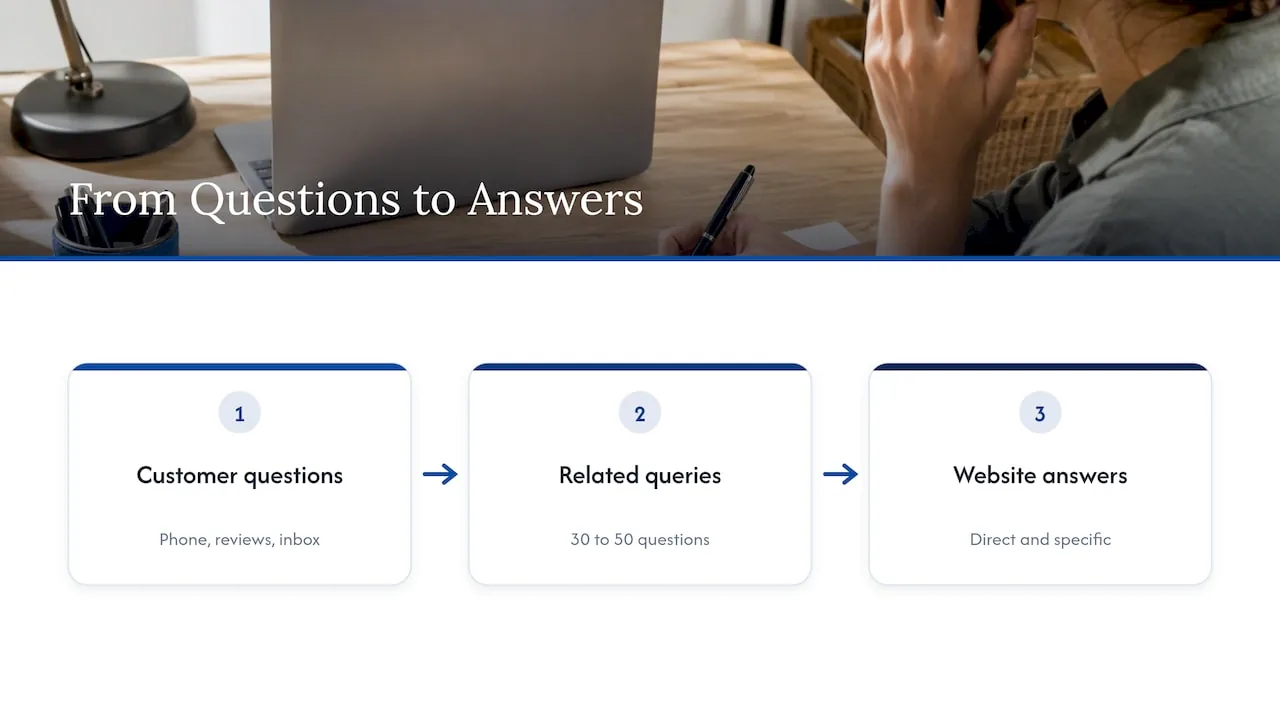
Ahrefs makes the point that authority is no longer about isolated keywords. It is about covering the full range of related queries in a topic, which helps a site hold up through algorithm updates and improves its odds of being pulled into AI answers. Practically: list the 30 to 50 questions customers ask on the phone, in reviews and in your inbox. Each deserves a direct, specific answer somewhere on your site.
Refresh before you publish
In competitive markets, updating an old page is often faster than writing a new one, because older pages tend to retain trust signals that can be refreshed. Before commissioning anything new, audit what you already have. Pages that rank on page two, pages with outdated pricing or rules, and thin service pages are your first targets.
Show real expertise on the page
Authority starts with credibility a human can check. For each important page:
- Put a named author or reviewer on it, with a short bio, license numbers where they apply, and links to their professional profiles.
- Use your own data and photos: job-site images, anonymized case outcomes where rules allow, real pricing ranges.
- Cite primary sources (regulators, professional bodies, manufacturers) rather than other marketing blogs.
- Date your pages and say when they were last reviewed.
This is also what AI answer engines favor. They are looking for passages that are specific, attributable and consistent with other sources about you.
Earn links and mentions the right way
Backlinks remain a core authority signal, but the quality bar has risen. Google’s systems have been designed to neutralize the impact of unnatural links, so paid placements and link networks buy you risk rather than rankings.
For a local business, the links worth chasing are the ones a well-known local business would naturally have:
- Local chambers of commerce and industry associations. Membership pages often link to your site and confirm you are real.
- Sponsorships and community events. Youth leagues, charity runs and school fundraisers publish sponsor lists.
- Local press and newsletters. Offer a useful, quotable expert for stories in your field: storm preparation, tax-season legal pitfalls, back-to-school dental advice.
- Supplier and partner pages. Manufacturers, associations and referral partners that list approved providers.
- Original resources. A cost guide with real local figures, a seasonal checklist or a local data roundup gets cited because it is useful.
A good rule: if the link would still make sense if search engines did not exist, it is probably a good link. Ten relevant local mentions beat a hundred generic directory submissions.
Prominence is also not something you can purchase. Google’s guidance, as we read it, is that it is built over time through reviews, reputable mentions and a digital footprint that corroborates what you claim. Our friends who work with service professionals describe the same pattern in other niches, for example how photos and reputation shape a Google Business Profile for officiants.
Make your entity unmistakable
Entity-driven SEO means search engines and AI tools should be able to answer three questions without guessing: who are you, what do you do, and where? Semrush’s 2026 guidance on authority points to consistent brand information across web sources, structured data and less reliance on JavaScript for key content.
A working checklist:
- One canonical name, address and phone number, written identically on your site, Google Business Profile, Apple and Bing listings, and major directories.
- Schema markup for your business type, locations, services, reviews where eligible, and the people behind the content.
- Crawlable content. Key service copy should be visible in the HTML, not injected late by scripts.
- An About page that states facts: founding year, service area, licenses, team, affiliations. Say only what is true and provable.
- Matching profiles on LinkedIn, industry directories and professional associations that point back to the same site.
If you want to understand how the pieces fit for both classic and AI search, our breakdown of the NSYGHT Stack explains how technical SEO, GEO, AEO and AI optimization work together. For the AI side specifically, this overview of AI SEO strategies is a useful outside read on preparing authority signals for AI retrieval alongside traditional search.
Reviews and your Google Business Profile
For local businesses, the Business Profile is the most visible place authority shows up. Google says that claiming and updating your information is the starting point for improving local ranking. After that, prominence signals do the heavy lifting:
- Review volume, recency and substance. Ask every satisfied customer at the moment of completion, with a direct link. Reply to every review, including critical ones, in a calm and specific way.
- Complete categories, services and attributes. Primary category first, then secondary categories that are true.
- Real photos of your team, location and work, added regularly.
- Posts and Q&A that reflect current offers and common questions.
For multi-location brands, consistency across locations is its own authority issue. Each location needs its own accurate profile and local page, not a copy of the others with the city name swapped. Our multi-location SEO guide covers the three moves we start with, and the dental practice guide shows what first moves look like in one regulated vertical.
What to skip
- Buying domain authority. Aged-domain redirects, link packages and private blog networks.
- Publishing for volume. Fifty thin posts dilute a site more than they help it.
- Chasing a score. Authority metrics from tools are useful for comparison, but a rising number with falling leads is a bad trade.
- Fake or gated reviews. They violate platform rules and erode the trust you are trying to build.
- Anonymous expert content in medical or legal topics.
Our perspective: authority is infrastructure
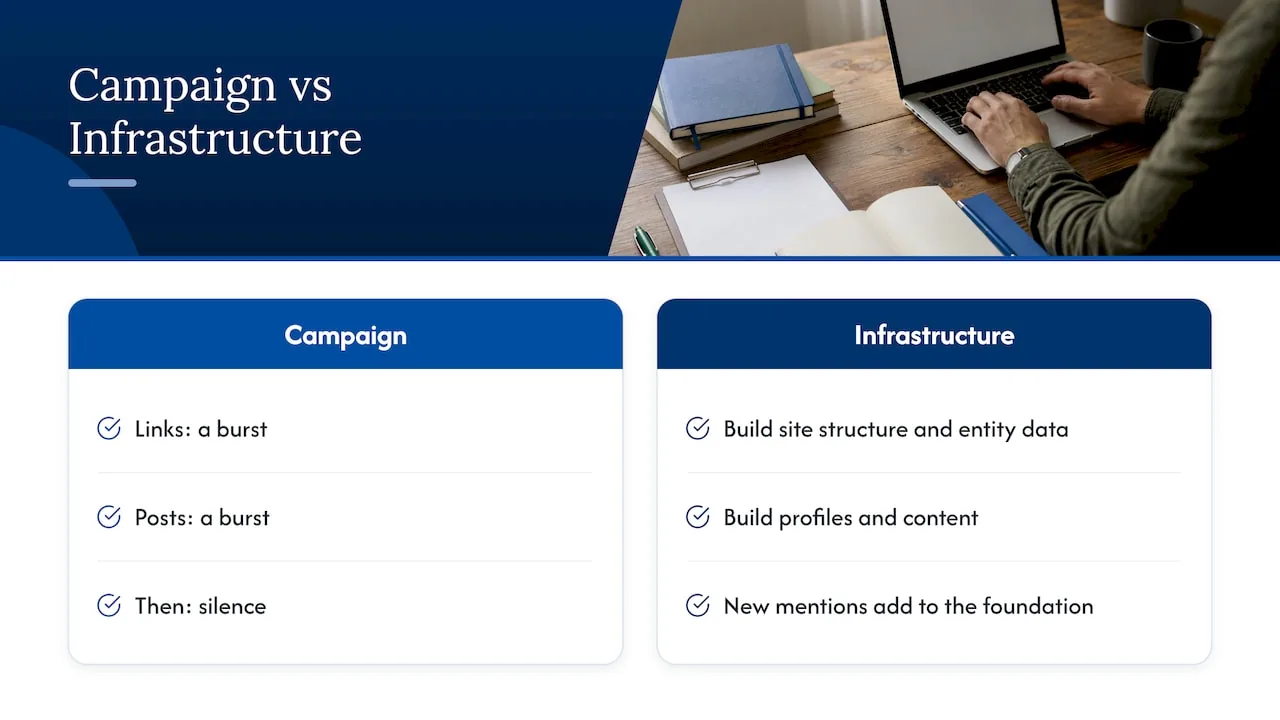
Most businesses treat authority as a campaign: a burst of links, a burst of posts, then silence. We treat it as infrastructure. The site structure, entity data, profiles and content have to be built so that every new review, mention or article adds to something that already holds together.
That is why we start with a technical and entity audit before any outreach. If your service pages are thin, your locations are inconsistent or your key content is hard to crawl, links and mentions have little to attach to. We work mainly with local service businesses, and the pattern repeats: the practices and firms that win in competitive markets are rarely the ones with the most links. They are the ones whose name, expertise and reputation line up in every place a search engine or an AI assistant checks.
We also think the line between SEO and AI search has mostly disappeared for authority purposes. The same signals, clear entities, consistent facts, corroborating third-party mentions and well-structured answers, feed both the local pack and AI-generated recommendations. You do not need two strategies. You need one that is built properly. We go deeper on this in our local business owner’s guide to AI search.
, NSYGHT
A 90-day authority plan
Days 1 to 30: foundation
- Audit crawlability, schema, name-address-phone consistency and Business Profile completeness.
- Identify your 3 to 5 core services and map one pillar page to each.
- Collect the full customer question list.
- Work through a local SEO checklist to catch gaps you would otherwise miss.
Days 31 to 60: depth
- Refresh the five weakest existing service pages with specifics, named authors and updated facts.
- Publish the first 6 to 10 cluster pages and link them to their pillars.
- Start a review request routine at job completion.
Days 61 to 90: reputation
- Pursue 5 to 10 local mentions: chamber, associations, sponsorships, local media.
- Publish one original local resource worth citing.
- Review local-pack positions, calls, direction requests and referrals from AI tools. Adjust.
Expect authority to compound rather than spike. Early wins usually come from fixing relevance and consistency. Prominence takes months.
How to tell it is working
Track outcomes first and proxies second:
- Rankings for your priority service-plus-city terms, and your position in the local pack.
- Calls, form fills and direction requests from your Business Profile.
- Branded search volume, which grows when more people know your name.
- Referring domains that are local and relevant, not just a higher count.
- Mentions or referrals from AI assistants when you test your core questions.
Where we can help
If you would rather have a team build this infrastructure with you, our SEO services cover entity-driven architecture, technical audits, on-page and off-page work and authority building, with transparent reporting. Business Profile work sits on its own page: Google Business Profile management. If you want a second opinion on your current plan first, consulting is available at 125 USD per hour through our services page. Law firms can see how this applies in SEO for law firms.
FAQ
How long does it take to build SEO authority?
Fixing consistency and thin pages can move local rankings within weeks to a few months. Prominence built on reviews, mentions and links takes longer, often six months to a year in competitive markets. Anyone promising authority in 30 days is either selling links or working on a very small niche.
Do backlinks still matter for authority?
Yes, but relevance and credibility matter more than count. A handful of links from local organizations, associations and publications your customers know is worth more than bulk directory links. Paid or networked links risk being neutralized or penalized.
Is topical authority different from domain authority?
Domain authority is a third-party score that estimates link strength across a whole site. Topical authority describes how thoroughly and credibly your site covers a subject. For a local service business, topical depth plus local reputation usually moves results more than a higher score.
Can a small local business compete with bigger brands on authority?
Often, yes. Local searches weigh relevance and proximity alongside prominence, so a focused business with strong reviews, accurate profiles and deep service content can beat a larger brand with generic pages. Pick a narrow service and city area and own it first.
Sources
- Tips to improve your local ranking on Google, Google Business Profile Help
- How to improve your local ranking on Google, Google Business Profile Help
- Topic clusters and pillar pages for SEO, Search Engine Land
- SEO Guide: Trust, Authority & Search Rankings, Search Engine Land
- Topical Authority: What It Is, How Google Measures It, and How to Build It, Ahrefs
- 10 Steps To Grow Your SEO Authority & Topical Expertise, Search Engine Journal
- 5 Ways to Increase Your Website Authority in 2026, Semrush
- Google’s Link Spam Policy Explained for Link Builders, eSEOspace