
Perplexity SEO means optimizing pages so AI retrieval systems can pull evidence-backed answers straight from the lead of your content. The single highest-impact move is putting factual, verifiable claims at the top of the page and refreshing them on a regular cadence. Do this well and you should see more citations in AI-generated answers, with your links appearing as the evidence behind those answers.
- Updating key statistics and current examples regularly can increase citation chances by up to 38%, often outperforming full rewrites for effort and impact.
- Ensuring the page's core factual content is easily crawlable, server-rendered, and high in the DOM avoids technical barriers to AI retrieval.
- Clear entity naming and a direct-answer structure with supporting sourced facts improve a page’s likelihood of being cited by Perplexity.
- Testing content updates gradually, such as refreshing stats or headlines separately, helps accurately measure what boosts AI citation performance.
How Perplexity retrieves and cites web content
Perplexity works like most retrieval-augmented generation (RAG) systems: it searches the web, pulls relevant passages, and hands them to a language model that writes an answer using those passages as grounding. The company's own Search as Code architecture takes this further by exposing retrieval, ranking, filtering, and rendering as programmable primitives that models can call directly. Instead of one search query, an AI agent might run several targeted retrievals and stitch the results together.
That changes what gets rewarded on the page. Perplexity's citation pipeline favors content that is fresh and fact-dense near the top, because extraction models tend to pull from the lead sections rather than scanning an entire article for buried details.
- Retrieval happens before generation, so a page has to be found and parsed before it can be cited
- Search as Code lets models issue multiple granular retrievals instead of one broad query
- Extraction leans heavily on the top portion of a page, roughly the first 30 to 40 percent
Which signals to optimize first for AI citations
Not every fix matters equally. Teams triaging a content backlog should rank work by citation impact, not by traditional keyword volume.
Freshness carries outsized weight. Perplexity citations often overlap with pages that already rank in Google's top 10, and Search Engine Land's analysis found that updating a page with current statistics or examples can raise citation frequency by roughly 33 to 38%. That is a bigger lift than most full rewrites deliver, and it costs a fraction of the effort.
Factual density beats rhetorical polish. A paragraph with three sourced numbers is more extractable than a page of persuasive prose with none. Verifiable citations, in particular, give the model something concrete to quote or paraphrase.
Placement decides whether any of this gets seen at all. A fact buried under three paragraphs of throat-clearing may never reach the extraction window, no matter how accurate it is.
- Refresh cadence: update statistics and examples on a fixed schedule rather than waiting for a full rewrite
- Factual density: lead with sourced numbers, not adjectives
- Lead placement: put your strongest evidence in the first few hundred words
- Entity clarity: name the people, organizations, and products your claims are about
Before rewriting a whole page, try refreshing just the stats and dates in the lead paragraph. It's often faster and, per Search Engine Land's data, can move citation frequency more than a full rewrite.
On-page tactics that make your content easy to cite
Write the lead as a direct answer, not an introduction. Two to four sentences, one clear claim, followed immediately by two or three sourced facts that back it up. That structure mirrors what extraction models are built to find.
- Open with a plain-language answer to the reader's likely question, no throat-clearing
- Follow with two or three sourced facts, each carrying a specific number, date, or named source
- Use semantic headers (H2 and H3) that match the actual questions readers ask
- Break supporting detail into short lists or a Q&A block instead of long paragraphs
- Place inline links on the exact phrase that states the claim, not on generic anchor text like "click here"
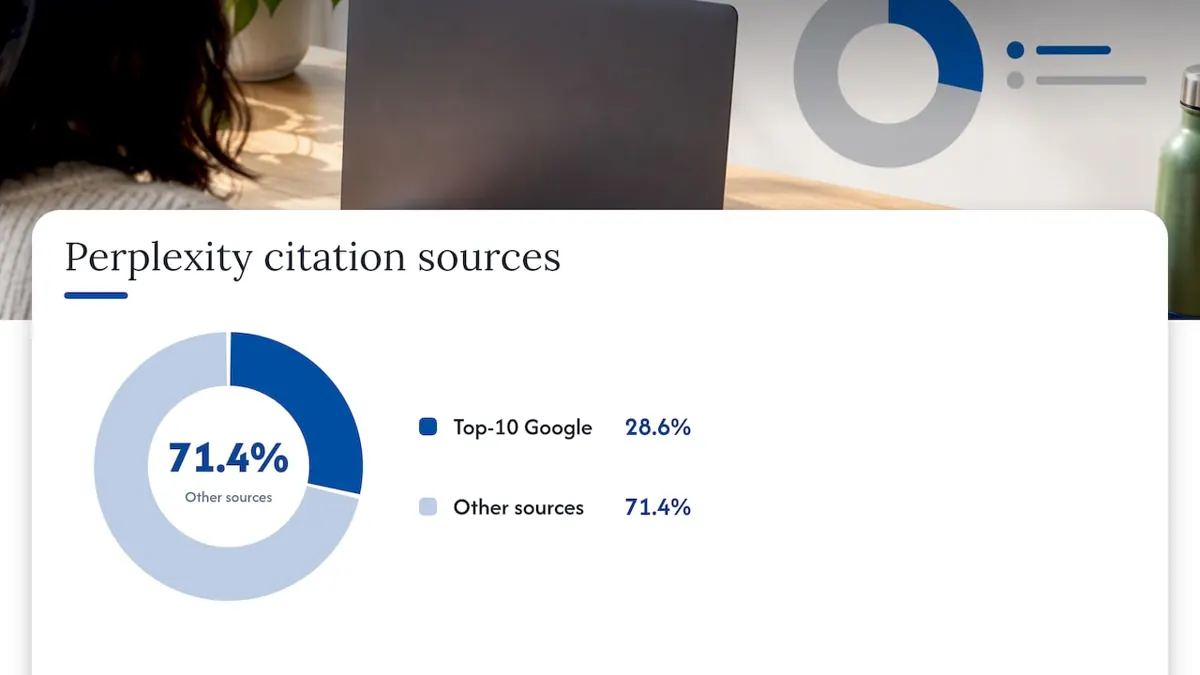
About 28.6% of Perplexity's citations come from pages that already rank in Google's top 10 organic results, which means strong traditional SEO still feeds AI visibility rather than replacing it.
On update cadence: refresh an existing stat or example when the underlying number changes or ages past its useful window, and publish new content only when the topic itself has shifted enough that a patch would misrepresent it. Regular review of key figures is generally enough to keep a well-structured page competitive without a full rewrite each time.
Technical readiness: crawlability and clean structure
None of the content work matters if Perplexity's crawler cannot reach or parse the page. A technical audit should confirm the basics before any content changes ship.
- Check robots.txt and CDN rules to make sure AI crawlers are not blocked alongside scrapers you actually want to stop
- Avoid rendering core factual content only through client-side JavaScript; server-render the facts you want extracted
- Use schema.org markup only when it mirrors the visible text on the page, since Google's own guidance confirms there are no special AI-only meta tags or file types, just standard crawlability and structured data that matches what users see
- Keep extractable facts high in the DOM and strip unnecessary UI clutter, popups, and carousels from around them
Google's generative AI optimization guide is explicit that foundational SEO practices, not exotic AI-specific tricks, remain the correct approach for eligibility in generative features.
Measure Perplexity visibility and iterate on what works
Treat every change as a test, because AI citation behavior is still noisy and third-party tools disagree with each other often.
- Track referral clicks originating from Perplexity in your analytics platform
- Watch for shifts in branded versus nonbranded query volume after a content update
- Use Search Console's generative reports where they're available, since Google notes that measurement for generative features is still developing
- Run small, isolated experiments, such as refreshing one statistic on one page, before committing to a full rewrite
Give any test days to weeks before judging results, and treat single-page samples with caution since citation behavior can shift for reasons unrelated to your edit.
Run one variable at a time. If you refresh a stat and rewrite the headline in the same update, you won't know which change moved the needle.
The NSYGHT method: entity-first structure in practice
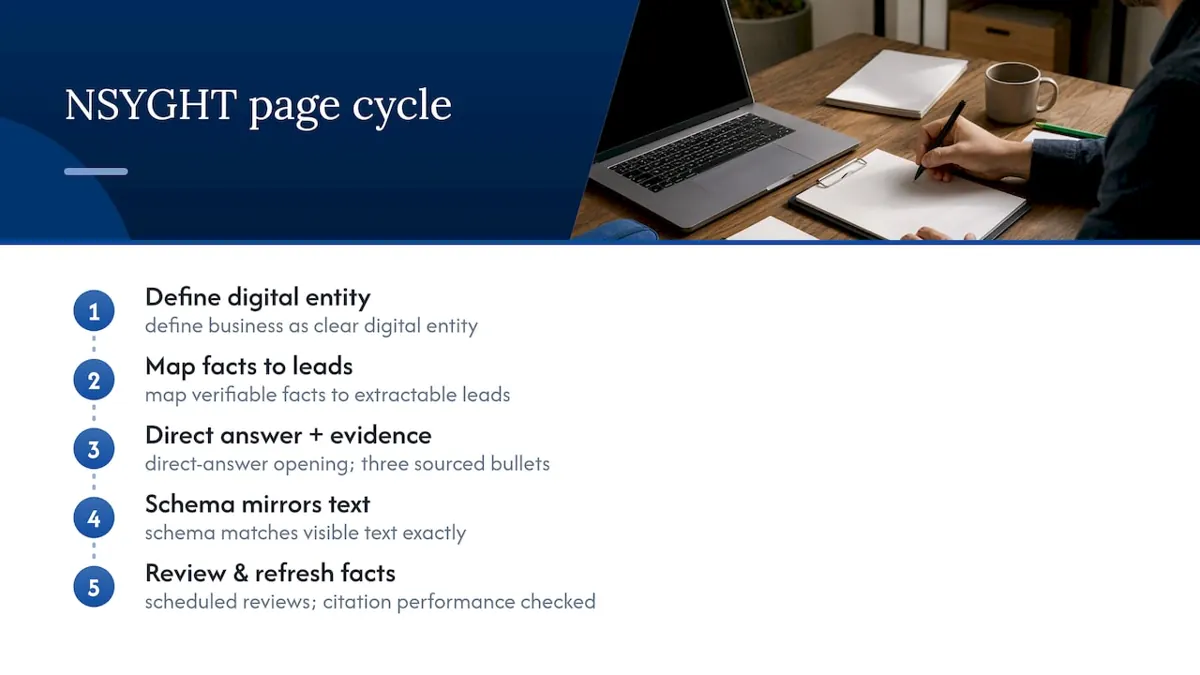
NSYGHT's approach, detailed in the NSYGHT Stack, starts by defining a business as a clear digital entity, then mapping its verifiable facts to extractable leads. A typical page follows a direct-answer opening, three evidence bullets with sources, and schema markup that mirrors the visible text exactly. Facts get reviewed and refreshed on a set schedule, with citation performance checked at each cycle rather than left to chance.
What SEO teams need to stop doing
Stop chasing AI as a black-box hack. Perplexity rewards verifiable facts placed early and refreshed often, not clever prompts or tags. Build citations into your editorial calendar as a distribution channel, not an afterthought.
How NSYGHT helps teams win AI citations
Getting cited by Perplexity takes the same discipline as ranking in Google, plus a layer of entity clarity most sites never build. NSYGHT's SEO services combine technical SEO with Generative Engine Optimization and Answer Engine Optimization so your facts are structured for both.
- GBP Management for local entity clarity that feeds both map packs and AI answers
- SEO Foundation, Growth, and Premium plans built around AEO/GEO integration
- Technical audits that check crawlability and structured data against what Google and Perplexity actually require
Teams that want hands-on help implementing this can request an SEO audit and see where their current content stands.
Sources
- Perplexity citations often match Google top-10 results; freshness boosts citations
- Rethinking search as code generation
- Google Search Central: Guide to optimizing for generative AI features on Google Search
Frequently Asked Questions
Perplexity can be a meaningful traffic and visibility channel because its citations often overlap with pages that already rank well in Google, according to Search Engine Land's analysis. Strong traditional SEO and fresh, fact-dense content both feed into how often a page gets cited.
Perplexity is an AI-powered answer engine that retrieves web pages and cites them as evidence inside generated answers, using a retrieval architecture the company calls Search as Code. For SEO professionals, it represents a citation target that rewards clear, verifiable, well-structured content rather than keyword density alone.
SEO is evolving, not disappearing. Google's own guidance confirms there are no special AI-only requirements for generative features, meaning crawlable, well-structured, people-first content remains the foundation for both traditional rankings and AI citations.
There is no single best AI tool for SEO since each platform, including Perplexity, ChatGPT, and Google's AI features, draws on different retrieval methods and citation behavior. The most reliable approach is optimizing for the fundamentals that Google's guidance and Perplexity's own architecture both reward: crawlable pages, matching structured data, and fact-dense lead content.
Refresh statistics and examples whenever the underlying numbers change or become outdated, since even small updates can measurably increase citation frequency according to Search Engine Land. A quarterly review of key facts is a reasonable starting cadence for most active pages.