
Generative engine optimization (GEO) is the practice of making content more likely to be retrieved, cited, and summarized by AI-powered search tools like Google's AI Overviews, Perplexity, and ChatGPT search. The first action to take is straightforward: audit your site's crawlability and indexing, then publish direct, evidence-backed answers to the questions your buyers actually ask. The workflow below shows how to do both.
- Up to 40% visibility improvement in AI search responses can be achieved with GEO tactics, but results depend heavily on the industry and content quality.
- Adding clear, evidence-backed answers, comparison tables, and third-party citations helps AI systems find and cite your content reliably.
- Ensuring your site is technically ready for crawlability, indexing, and rendering remains crucial, as GEO builds on traditional SEO foundations.
- Focus on earning independent mentions and authoritative sources, since generative engines prefer third-party citations over brand-owned pages.
- Measure citation frequency, AI-driven impressions, referrals, and conversions to track GEO effectiveness, using tools like Google Search Console and specialized AI visibility platforms.
What generative engine optimization actually means
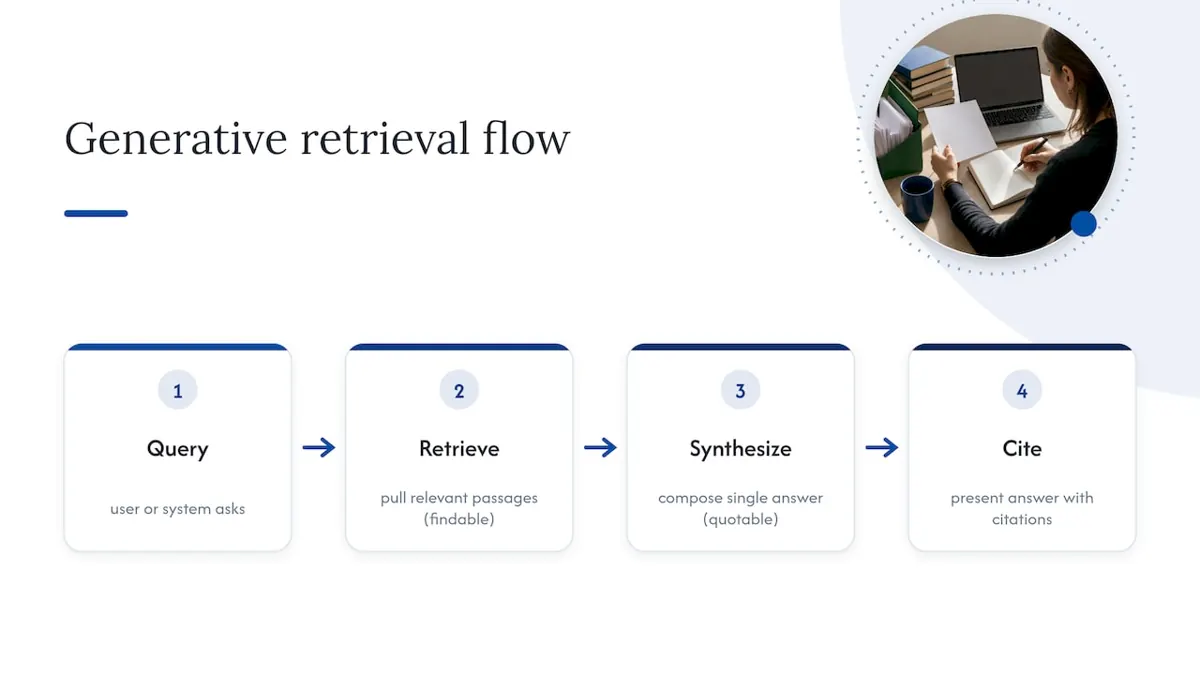
Generative engines work differently from classic search. Instead of returning ten blue links, they retrieve passages from multiple sources, synthesize them, and present a single answer with citations attached. That shift was formalized in a 2024 ACM SIGKDD paper that introduced GEO as a discipline and built GEO-bench, a benchmark of 10,000 diverse queries used to test how generative engines like Perplexity select and cite sources.
The mechanics matter for anyone creating content. Generative engines typically rely on retrieval-augmented generation, pulling relevant passages before composing an answer, which means a page needs to be both findable and quotable. Clear entity definitions, scannable structure, and evidence that can stand on its own outside the page's original context all affect whether a passage gets picked up.
You will see this practice called by several names: AEO (answer engine optimization), AIO (AI optimization), or simply "AI SEO." The terms overlap heavily and no governing body has standardized them. What matters is the underlying goal: becoming a source an AI system trusts enough to cite, not just a page that ranks.
SEO vs. GEO: what changes and what still matters
Generative engine optimization is not a replacement for search engine optimization: it is built on top of it. If a page cannot be crawled, indexed, or rendered, it never enters the pool of candidates a generative engine draws from. Indexing, clean semantic HTML, and fast, accessible pages remain the foundation.
What changes is the emphasis once that foundation is in place. Generative engines reward content that makes claims easy to verify and lift out of context, which means teams need to add elements that traditional SEO often treated as optional.
- State direct answers near the top of a page instead of burying them under narrative lead-in.
- Add explicit comparison elements such as pros and cons lists, spec tables, and dated figures.
- Cite sources for factual claims so an engine can verify and attribute them.
- Pursue earned mentions on third-party sites, since citations from independent sources carry more weight in generative answers.
The practical move for an existing page is often small: add a clearly labeled answer paragraph, a comparison table, or a sourced statistic rather than rewriting the whole piece.
Why GEO matters now: the evidence behind the shift
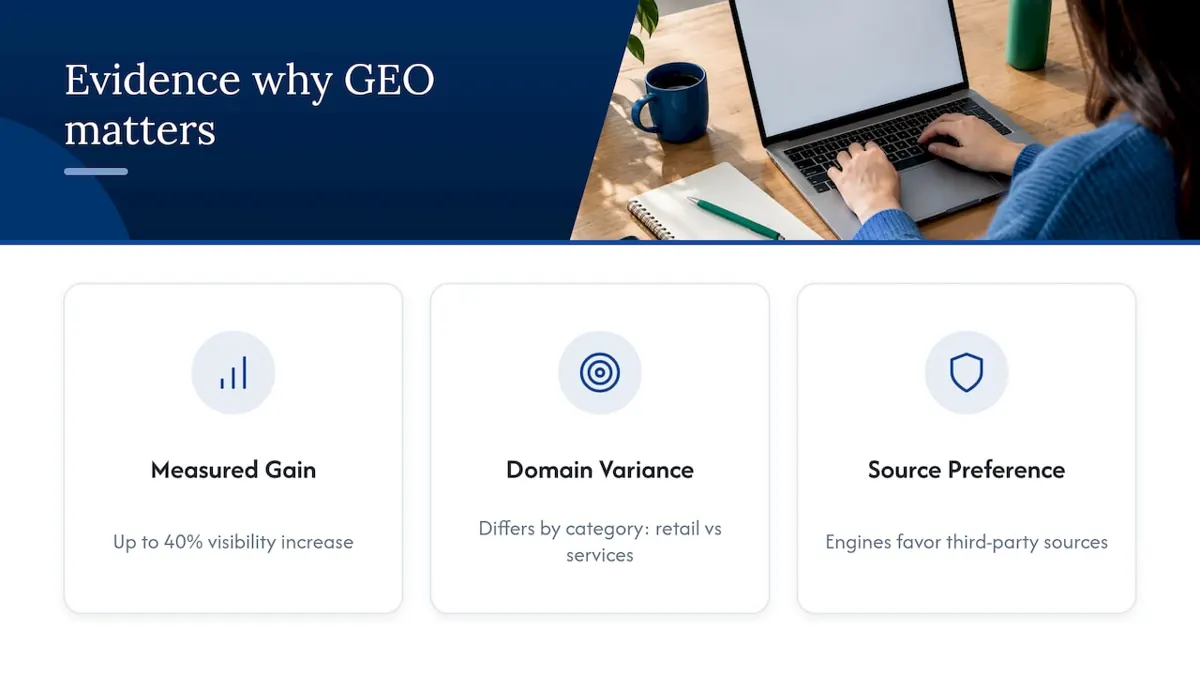
The case for prioritizing GEO is no longer theoretical. In the GEO-bench evaluation, tested optimization methods increased a page's visibility in generative-engine responses by a substantial margin, though the ACM SIGKDD research is clear that results vary significantly by domain, with retail and review-heavy categories behaving differently from service or local business categories.
Visibility gains from GEO tactics reached up to 40% in controlled testing, according to the GEO-bench benchmark, though effectiveness depends heavily on the category tested.
That variance is the real lesson: GEO is not a universal switch but a set of tactics that need domain-specific testing. Separate cross-engine research found that generative engines often favor earned, third-party authoritative sources over brand-owned pages when synthesizing an answer, which changes how AI answers shape buyer behavior. Instead of browsing a list of options, a reader often sees a single synthesized recommendation with a short list of cited sources behind it.
Smaller sites with clear, well-justified content stand to gain the most, since generative engines do not weight domain size the way traditional rankings sometimes do. Sites that keep publishing vague, unsupported claims risk losing visibility to competitors willing to do the sourcing work.
A step-by-step GEO workflow you can start this week
Treating GEO as a structured workflow, rather than a one-time project, keeps the work from turning into guesswork.
- Define priority prompts. List the actual questions and intents your buyers type into AI tools, not just the keywords you rank for today.
- Check technical readiness. Confirm crawlability, indexing, and rendering of JavaScript-heavy pages, and review the Search generative AI control in Search Console to see what Google can include from your site.
- Rewrite for direct answers. Open sections with a plain-language answer, state the scope and date of any claim, and cite the evidence behind it.
- Add justification elements. Pros and cons lists, spec comparisons, and labeled data points give engines material that is easy to lift and attribute, a pattern feature-level research found more durable than small wording tweaks.
- Earn third-party mentions. Pursue coverage, reviews, and citations on independent sites, and keep a record of where your content gets referenced.
- Test across engines and iterate. Run the same prompts through multiple AI tools, note which pages get cited, and update underperforming content rather than starting over.
Our own implementation of this process ties directly into entity-driven GEO fundamentals, where defining a brand's entity clearly is the prerequisite for everything downstream.
Start with the five prompts your sales team hears most often. Winning those first builds a template for the rest of your content.
How to measure GEO performance and which tools to use
GEO needs its own measurement layer because ranking position does not capture whether an engine actually cited you. The metrics worth tracking include how often your brand appears as a cited source, impressions from AI-driven search features, referral clicks from generative results, and any shift in conversions tied to that traffic.
- Review Google's Generative AI performance report alongside standard Search Console data to see how AI features surface your pages.
- Check Bing Webmaster Tools for parallel visibility into Microsoft's AI-powered search features.
- Use AI visibility platforms such as AuthorityLayer to monitor citation frequency and competitive positioning across multiple generative engines.
- Keep legacy SEO tools in the stack where they have added AI-specific tracking, since they still cover traditional ranking and crawl data.
A simple experimental approach works best: pick a handful of pages, make one documented content change, and compare citation frequency and referral traffic before and after across at least two engines. That controlled comparison tells you more than any single platform's dashboard.
Official guidance and the myths worth ignoring
A lot of "GEO hacks" circulating online do not hold up. Publishing an llms.txt file, forcing content into rigid chunks, or stuffing pages with repeated keywords for "token optimization" is not endorsed by engines and often degrades readability for actual visitors.
Google's own developer guidance states plainly that there is no ideal page length and that special AI text files or mandatory chunking are not necessary for its generative features. The recommendation instead is to keep investing in technical SEO fundamentals, publish genuinely useful and unique content, and use the Search generative AI controls and reporting already built into Search Console.
Chasing inauthentic mentions or manipulated citations is also a dead end: engines favor earned, verifiable authority, not volume. Test any new tactic on a small set of pages before rolling it out broadly, since behavior differs across engines.
How we operationalize GEO through the NSYGHT Stack
Our approach combines technical SEO, GEO, and AEO into what we call the NSYGHT Stack, built on the idea that a business needs a clearly defined digital entity before any generative engine can cite it with confidence. The process runs in four stages: an audit of technical readiness and current AI visibility, a prioritized roadmap based on the prompts that matter most to a client's business, implementation of entity-driven content and structural changes, and ongoing measurement against citation frequency and AI-driven referral traffic. This mirrors the workflow outlined above, applied to the local and multi-location service businesses we work with.
Where GEO is headed next
Generative engines will likely keep leaning harder on grounding and third-party authority rather than brand self-description, which rewards sites that earn independent coverage over those that only publish about themselves. The near-term priority list is short: measure what actually gets cited, build earned mentions deliberately, and keep entity claims precise. None of that should come at the cost of readable, conversion-focused pages built for actual people.
How we can help you put GEO into practice
Implementing everything above takes time most marketing teams do not have free, which is where a focused engagement helps. Our SEO services cover the ground this article describes: SEO Foundation for sites that need the technical and content base in place, SEO Growth for teams ready to build out GEO-specific content and earned mentions, and SEO Premium for multi-location brands running the full NSYGHT Stack.

A typical engagement follows the same shape as the workflow above:
- Audit of current crawlability, indexing, and AI visibility.
- Prioritized roadmap built around the prompts your buyers actually use.
- Implementation of entity-driven content, technical fixes, and earned-media outreach.
- Ongoing measurement of citation frequency and AI referral performance.
If you want a clear-eyed look at where your site stands today, reach out for an audit and we will walk you through what we find.
Frequently Asked Questions
Generative engine optimization is the practice of structuring and sourcing content so AI-powered search tools are more likely to cite it in synthesized answers. It builds on traditional SEO foundations like crawlability and indexing, then adds direct answers, clear sourcing, and scannable comparison elements.
Traditional SEO focuses on ranking a page in a list of results, while GEO focuses on getting a page cited inside a single AI-generated answer. The technical groundwork (indexing, semantic HTML, fast pages) stays the same, but GEO adds emphasis on verifiable claims, justification content, and earned third-party mentions.
No. Google's developer guidance states that special AI files such as llms.txt and mandatory content chunking are not necessary for its generative search features. The guidance instead points to continued technical SEO and genuinely useful, unique content.
In the GEO-bench benchmark, tested optimization methods increased visibility in generative-engine answers by up to 40%, though results varied considerably by domain. That range should be treated as a ceiling from controlled testing, not a guaranteed outcome for every site.
Track citation mentions in AI-generated answers, impressions from AI-driven search features, referral clicks from those features, and any resulting shift in conversions. Google's Generative AI performance report inside Search Console is a useful starting point alongside dedicated AI visibility tools.
Sources
- GEO: Generative Engine Optimization | Proceedings of the 30th ACM SIGKDD Conference
- Optimizing your website for generative AI features on Google Search | Google Search Central
- Think Before Writing: Feature-Level Multi-Objective Optimization for Generative Citation Visibility (FeatGEO)
- Generative Engine Optimization: How to Dominate AI Search (arXiv)