
Answer engine optimization (AEO) is the practice of structuring content so AI systems like ChatGPT, Perplexity, and Google's AI Overviews can extract, quote, and cite it directly in their answers. The immediate payoff is brand visibility inside a response the user never has to click through to find. Get the chunk structure and entity signals right, and your brand starts showing up as the cited source instead of the ignored link ten results down.
- Ensuring each content chunk answers a specific question in the first 40 to 80 words greatly increases the likelihood of being cited by AI answer engines.
- Marketers should prioritize rewriting high-traffic pages with clear BLUF (bottom line up front) formats, applying schema, and building entity-driven content structures for better citations.
- AEO success is measured through citation frequency, brand mentions, and fan-out coverage rather than traditional click-based metrics.
- Avoid relying on superficial hacks such as artificial mentions or code manipulations; focus instead on genuine, helpful content aligned with SEO fundamentals.
- Long-term AEO effectiveness depends on consistent auditing, templating, and governance, with initial focus on high-intent pages and building internal measurement capacity.
What Is AEO and How Do AI Systems Pick What to Cite?
Every major AI answer engine runs on some version of retrieval-augmented generation, or RAG. When someone asks a question, the system doesn't read your whole page. It retrieves the smallest relevant piece, a "chunk," usually a paragraph or section, and feeds it to the language model to synthesize into an answer. That means your unit of optimization isn't the page anymore. It's the chunk.
A citeable chunk answers its own question completely in the first 40 to 80 words, without depending on a pronoun or a sentence three paragraphs up to make sense. This is the same BLUF (Bottom Line Up Front) principle newsrooms have used for decades, applied to machine retrieval. A chunk built for extraction usually includes:
- A direct answer in the opening sentence, not a lead-up
- Named entities, specific numbers, or a named standard instead of vague references
- A heading phrased as the actual question a user would type
- No reliance on "it," "this," or "that" pointing back to a different section
Write each section as if it could be lifted out of your page entirely and still make complete sense on its own, because that's exactly what happens when an answer engine cites it.
Why Does AEO Matter for Marketing Now?
The business case isn't theoretical. Gartner has projected a meaningful drop in traditional search engine volume as AI chatbots and virtual agents absorb more of the discovery process. Fewer searches land on a traditional search results page with multiple links. More land inside a generated answer with maybe two or three citations attached.
The conversion gap is the real story here. Traffic referred from ChatGPT-style experiences converts at rates up to nine times higher than traffic from traditional search, according to research cited in Forbes. Users treat these tools as trusted advisors, not link directories, so a citation arrives with built-in credibility a standard search result doesn't carry.
That shift changes what "success" looks like for a lot of queries. A zero-click answer that name-drops your brand as the recommended option can beat a click that lands on a page the user immediately bounces from. Practical implications for marketers:
- Prioritize being the cited source over ranking position alone
- Treat AI citations as a new, measurable channel, not a side effect of SEO
- Rewrite brochure copy into the conversational, question-first language your support team already hears
How Is AEO Different From Traditional SEO?
AEO doesn't replace SEO. It sits on top of it. If your pages aren't crawlable, indexed, and backed by genuine topical authority, no amount of chunk formatting will save you. Answer engines still need a page to find and trust before they'll ever quote it.
Traditional SEO handles the foundation:
- Technical crawlability, site speed, and clean indexing
- Backlink authority and domain trust signals
- Comprehensive topic coverage across a site
AEO adds a citation layer on top of that foundation, focused on making individual chunks extractable and quotable. Generative Engine Optimization (GEO) is closely related but distinct. Where AEO focuses on getting discrete facts pulled into an answer, GEO concerns itself with how your content gets synthesized and paraphrased across an entire AI-generated summary. In practice, the same SEO team usually owns both, just with an added editorial pass focused on structure rather than a separate department.
What Are the Best AEO Strategies for Marketing Teams?
Treat this as a build order. Each step depends on the one before it.
- Rewrite section openers with BLUF. Every H2 or H3 should answer its own question in the first sentence or two, using named entities and specific figures instead of vague setup.
- Apply schema deliberately. Use FAQPage schema for genuine Q&A content, Article schema for editorial pages, and HowTo schema for sequential processes. Don't force schema onto content that isn't actually structured that way.
- Build entity-driven architecture. Pillar pages with clearly defined topic clusters help large language models disambiguate your brand from competitors with similar names or offerings, which raises the odds you get cited instead of a rival.
- Align titles and meta descriptions semantically. Pages with tighter semantic alignment between their meta description and their actual content receive more AI citations than low-alignment pages. This is a fast, low-cost fix most teams skip.
- Add multimodal and accessibility signals. Alt text, transcripts, and clear table captions all give answer engines additional extractable text your competitors probably aren't providing.
Run a “can this paragraph stand alone” test on your top 20 pages. Copy just one section into a blank document. If it doesn't make full sense without the rest of the page, an AI system will struggle to cite it too.
One thing to skip: forced hacks. Google has explicitly advised prioritizing standard SEO fundamentals like topical authority and genuinely helpful content over artificial chunking tricks or manufactured mentions.
How Do You Measure AEO Success?
AEO measurement is younger and messier than click-through rate tracking, but a handful of metrics are becoming standard practice among marketing teams running these programs.
- AI citation frequency: how often your brand or content gets quoted across AI platforms for a defined set of target queries, tracked through manual prompt testing or emerging AI-monitoring tools
- Brand mention rate: mentions of your brand name inside AI answers, regardless of whether a link accompanies it
- Share of voice: your citation count relative to competitors across the same query set
- Fan-out coverage: how many related sub-questions around a core topic your content successfully answers, since answer engines often break one query into several smaller ones
- Zero-click trend: the shrinking ratio of impressions to actual site clicks, tracked in Google Search Console over time
Short-term, watch fan-out coverage and citation frequency on a rolling basis; they respond to content changes within weeks. Share of voice and mention rate move slower and need a quarter or more of data before trends mean anything. Attribution stays imprecise here. Most AI platforms don't hand over referral data the way Google Analytics does for organic search, so treat these metrics as directional signals, not exact conversion math.
What Are the Biggest AEO Mistakes to Avoid?
The most common failure mode is treating AEO as a collection of tricks instead of a discipline. Google has been direct about this: chasing hacks like artificial content chunking, llms.txt files, or manufactured mentions wastes effort that should go toward genuinely helpful, well-organized content. There's no official standard requiring an llms.txt file, and no evidence it improves citation rates.
Other recurring problems:
- Chasing inauthentic mentions. Buying placements or stuffing brand names into unrelated content erodes the topical authority that actually earns citations.
- Extraction-killing dependencies. Content that leans on JavaScript rendering, gated PDFs, or images with no alt text often never reaches the retrieval layer at all.
- Scaling without governance. Teams that rewrite hundreds of pages for BLUF formatting without an editorial checklist tend to introduce inconsistent tone and duplicate answers across the site.
The fix for most of this is boring but effective: a shared style guide, a review step before publishing, and periodic re-testing of how your top pages actually perform in AI answers.
What Should Be on a 90-Day AEO Implementation Checklist?
- Audit first, in weeks one and two. Map your highest-traffic and highest-intent pages against real user questions, and flag the gaps where competitors are getting cited and you aren't.
- Build templates in weeks three and four. Lock in a BLUF-first section template, a FAQ schema template, and metadata rules your whole content team can reuse without reinventing structure every time.
- Instrument tracking by week six. Set up recurring prompt testing across the AI platforms your customers actually use, and connect fan-out coverage and zero-click trend data to your existing reporting.
- Formalize governance by week ten. Train writers and editors on the checklist, then run a testing cycle every 30 days to catch drift.
Start with your highest-intent commercial pages, not your blog archive. A citation on a service page next to a buying decision is worth more than a citation on a five-year-old listicle.
How Does NSYGHT Approach AEO, GEO, and AIO?
NSYGHT builds what we call entity-driven SEO architecture: a foundation where your business is defined clearly and consistently across schema, pillar content, and citation-ready structure before any AEO tactic gets layered on top. That sequencing matters. AEO tactics applied to a poorly defined brand entity just amplify confusion.
In practice, this means:
- Technical audits that map where your current content fails the extraction test
- Schema and content engineering built around how our full stack connects SEO, GEO, and AIO rather than treating them as separate projects
- Local pack and AI referral tracking built into standard reporting, not a separate add-on
At scale, this looks less like one big rewrite and more like a rolling audit and template rollout across every location or service line a client operates.
Where Should Marketing Leaders Put Their AEO Budget First?
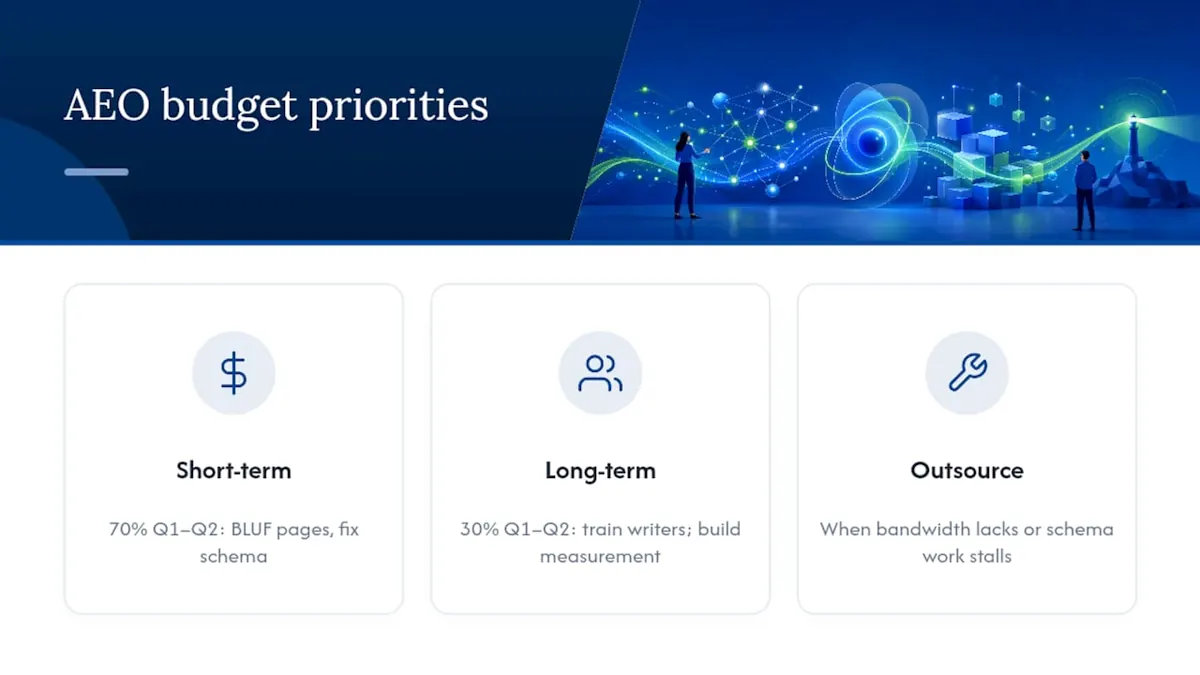
Split resources roughly 70/30 in the first two quarters: 70 percent toward short-term wins, meaning rewriting your highest-traffic pages into BLUF chunks and fixing schema gaps, and 30 percent toward long-term capability, meaning training writers and building measurement infrastructure. Flip that ratio once the fundamentals hold.
Bring in outside help when your team lacks bandwidth for consistent testing, or when technical schema work keeps stalling against other engineering priorities. Build internal capability in stages: audit and template first, in-house ownership of measurement second, full editorial independence last.
Get Managed Support for Your AEO Rollout
Running an AEO audit, rebuilding chunk structure across dozens of pages, and wiring up schema correctly takes real hours most internal marketing teams don't have sitting idle. Entity architecture, schema engineering, and citation tracking are handled as one connected system rather than through multiple separate vendors, to provide a more coherent AEO program.
Our AEO services start with a technical audit that maps exactly where your current pages fail the extraction test and where competitors are already winning citations you should own. From there, we build the templates, apply schema where it actually fits, and set up the tracking to prove it's working. If you're ready to see where your brand stands in AI-generated answers today, request an SEO consultation and we'll walk you through what a 90-day rollout looks like for your specific market.
Sources
- Answer Engine Optimization: The Complete 2026 Guide | Similarweb
- Google's Guide to Optimizing for Generative AI Features on Google Search | Google Search Central
- Answer Engine Optimization, What Brands Need To Know | Forbes
- Semantic SEO guide | Search Engine Land
Frequently Asked Questions
Start by rewriting your top pages so each section answers its own question in the first sentence, then add appropriate schema and build entity-clear pillar content. NSYGHT's AEO framework walks through this sequencing in more detail.
SEO makes your pages crawlable, indexed, and authoritative. AEO builds on that foundation to make individual sections extractable and quotable by AI systems, functioning as an added layer rather than a replacement.
There's no single dominant tool yet; most teams combine manual prompt testing across AI platforms with schema validators and existing analytics like Google Search Console to approximate citation performance.
AEO focuses on getting specific facts or chunks quoted directly in an AI answer. GEO focuses on how your brand and content get paraphrased and synthesized across a broader AI-generated summary.