

NAP consistency means the exact, identical Name, Address, and Phone number appearing everywhere you are listed online, on your website, your Google Business Profile, and every directory that mentions you. The immediate move is to pick one canonical version of your NAP and publish it in your site footer and on your Google Business Profile first. Consistency supports local visibility and cuts down on lost calls and missed visits from customers who land on outdated information.
- Maintaining NAP consistency across all online listings ensures the correct, up-to-date information is displayed, improving local visibility and avoiding lost calls or visits.
- Common issues include formatting mismatches, unpropagated changes after moves, duplicate listings, and errors from data aggregators that can distort search results.
- Prioritize fixing your website and Google Business Profile first, then audit major directories and aggregators, documenting every discrepancy for ongoing management.
- Conduct monthly audits with strict formatting rules and schema markup to prevent NAP drift, especially for multi-location or frequently moving businesses.
- Hiring an agency is advisable for multi-location brands or those with complicated histories to ensure ongoing accuracy, while single-location owners can usually manage with a simple checklist.
What NAP means and where it shows up online
Your NAP has three parts: Name, Address, and Phone number, written exactly the same way every time. Some practitioners add a "W" for website, since a mismatched or missing URL can muddy a listing just as badly as a wrong suite number. Moz describes NAP consistency as the uniform presentation of these details across listings, calling it foundational to local search.
Your information lives in more places than most owners realize:
- Google Business Profile, the primary record Google uses for local search and maps
- Your own website, especially the footer and contact page
- General directories like Yelp and Yellow Pages
- Industry-specific directories tied to your trade or profession
- Social profiles on Facebook, Instagram, and LinkedIn
- Data aggregators that license and redistribute business information
- Review sites that pull listing details alongside customer feedback
Google compiles what it shows searchers from a mix of crawled web pages, licensed third-party data, and contributions from users, according to Google's own explanation of how it sources local information. That mix is exactly why a single wrong address on one directory can quietly work its way into search results.
Why NAP consistency drives rankings and conversions
Google's local ranking guidance centers on relevance, distance, and prominence, and NAP accuracy touches all three. A profile with clean, matching details helps Google confirm you are a real, locatable business worth surfacing for a given search. Google's own guidance states that businesses with complete and accurate information are more likely to appear in relevant local searches.
Complete, accurate business profiles are more likely to surface in relevant local searches, per Google Business Profile guidance. That single fact explains a lot of day-to-day local pack volatility that owners blame on algorithm changes.
Beyond rankings, NAP accuracy is a conversion issue. A mismatched phone number means a customer calls a disconnected line or, worse, a competitor. A stale address sends foot traffic to the wrong strip mall. Knowledge panels pull from the same messy data, so an inconsistent NAP can surface the wrong hours or an old location right in the search results, costing you the click before the customer ever reaches your site.
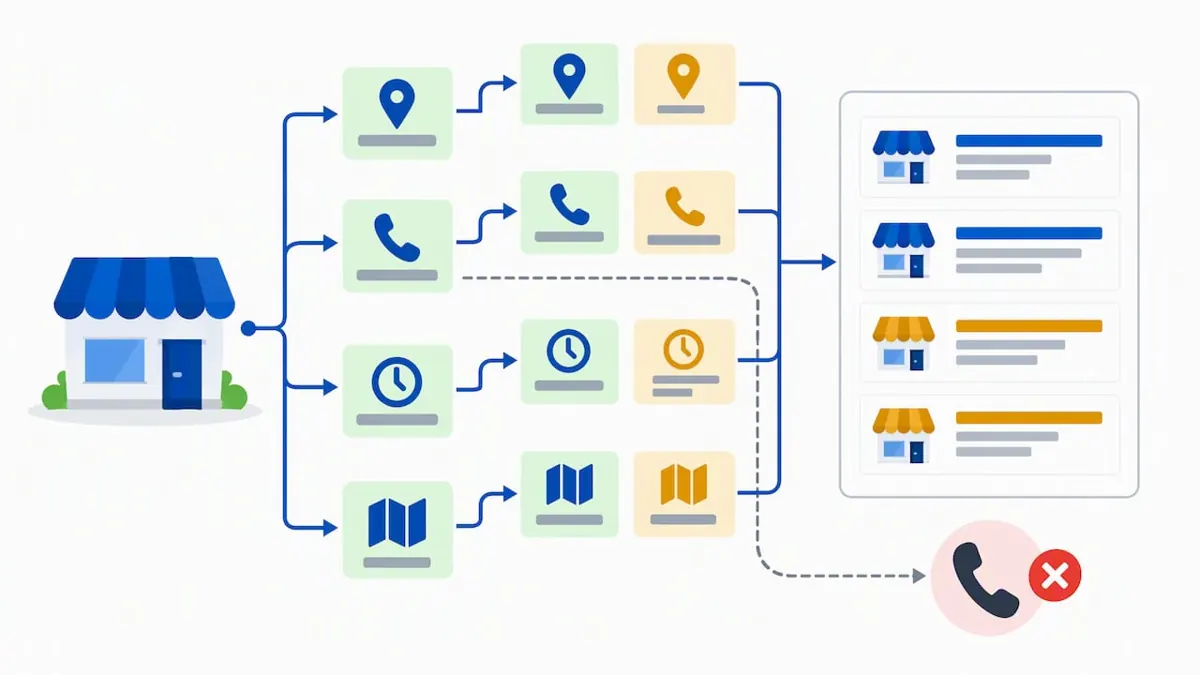
Common NAP citation problems worth checking first
Most NAP problems fall into a handful of repeat offenders. Here is what shows up most often during an audit, roughly in order of how often it causes real damage:
- Formatting mismatches: "St." versus "Street," "Suite 200" versus "#200," or inconsistent punctuation in phone numbers.
- Unpropagated phone changes: a new number updated on the website but never pushed to directories, often tangled up with call-tracking numbers that were never documented.
- Duplicate or unclaimed listings: old profiles from a previous owner, a defunct location, or an auto-generated directory entry nobody claimed.
- Partial updates after a move or rebrand: the website gets the new address, but ten directories still list the old one.
- Category and name mismatches across locations: a franchise location listed under a slightly different name or business category than its sister locations.
- Aggregator-specific errors: data brokers that license information in bulk can propagate an old mistake to dozens of smaller directories at once.
CallRail's research on NAP consistency highlights call-tracking confusion and move-related inconsistencies as two of the more persistent issues local businesses run into.
How to run a NAP audit step by step
Start by defining your canonical NAP exactly as it should appear everywhere: full legal or trade name, standardized address format (spell out or abbreviate consistently, pick one suite format), and one phone number written the same way every time, including area code formatting. Google's guidelines on business representation ask for the same name across every location in a given country, which matters even more once you have more than one storefront.
Work through sources in priority order:
- Claim and verify your Google Business Profile first; it carries the most ranking weight.
- Check your website footer, contact page, and any embedded schema markup.
- Audit top general directories and review sites (Yelp, Yellow Pages, Facebook).
- Check major data aggregators, since errors there can spread to smaller sites.
- Review your social profiles for outdated addresses or numbers.
- Check niche or industry-specific directories relevant to your trade.
- Scan backlinks and press mentions for old citations worth a correction request.
Log every discrepancy as you find it so nothing gets fixed twice or missed entirely.
Use Google's Rich Results structured data testing tool to confirm your schema reads correctly, run site search queries (site:yourdomain.com) to catch stray old pages, and check aggregator lookup pages directly rather than relying on memory. For businesses with a dozen or more locations, a batch listing management service can save weeks of manual checking.
Fix your website and Google Business Profile before touching a single directory; those two sources carry the most weight and the fewest propagation delays.
Fixing citations and building a maintenance routine
Correct the highest-authority sources first: your website and Google Business Profile, since Google draws heavily from crawled web content and your profile data when deciding what to show searchers. Once those are right, work outward to directories and aggregators, documenting each correction as you go so you have a record if an old version resurfaces.
A few habits keep NAP drift from creeping back:
- Add your canonical NAP to LocalBusiness schema markup on every page where it appears, not just the contact page.
- Keep schema and visible text identical. Mismatched structured data and page content creates its own kind of inconsistency.
- Reserve call-tracking numbers for channels where attribution matters, and document every tracking number against your canonical listing so nobody mistakes it for an error.
- Keep a running change log with the date, what changed, and who made the change.
- Assign one owner for NAP governance rather than leaving it to whoever notices a problem.
If you use call-tracking numbers for ads or print campaigns, list your canonical number on Google Business Profile and your website, and keep tracking numbers confined to the specific channel they measure.
Multi-location businesses benefit from scheduling recurring audits, monthly for active, fast-growing brands, quarterly for stable single-location operations, rather than waiting for a ranking drop to prompt a review.
Operational habits that keep NAP data clean
We treat the website as the canonical source of truth for client engagements, publishing machine-readable LocalBusiness schema that mirrors the visible NAP exactly. That single habit resolves a surprising share of the inconsistencies we find during initial audits.
A few operational rules we apply across accounts:
- Run monthly audits rather than annual ones, since directory data degrades faster than most owners expect.
- Keep an edit log with the owner's name and date attached to every change, not just a mental note.
- Enforce strict formatting rules for abbreviations, suite numbers, and phone punctuation so no two team members write the address differently.
Disciplined NAP governance is not just a local SEO checkbox. It is part of the entity-driven approach we rely on to keep a business's digital footprint stable across local packs and AI-generated answers alike, since both depend on consistent, verifiable business data.
Deciding between handling it yourself and bringing in help
A single-location business with a handful of listings can usually manage a NAP audit in an afternoon using the checklist above. Multi-location brands, frequent movers, or anyone seeing repeated duplicate listings and unexplained ranking drops tend to benefit more from a managed engagement that includes audit, remediation, and aggregator escalation. An agency engagement typically covers the full audit, direct outreach to correct stubborn listings, and ongoing reporting so drift gets caught early.
How we help local businesses keep their listings in order

Keeping NAP data clean across dozens of directories, aggregators, and social profiles takes real time, which is exactly where our GBP Management and SEO Foundation services come in. We handle the audit, the corrections, and the recurring checks so a client's canonical NAP stays intact across every surface Google and AI tools pull from.
What that looks like in practice:
- A full citation audit across directories, aggregators, and social profiles
- Google Business Profile claiming, verification, and ongoing management
- Schema implementation that keeps your website's machine-readable data aligned with what customers see
- Monthly reporting so you can see what changed and why
For businesses juggling more than one location or a history of moves and rebrands, centralizing this work reduces drift and keeps your local pack presence steady instead of reactive. If you want a second set of eyes on your current listings, our Google Business Profile management page outlines how we structure that work, or you can look at our broader local SEO checklist to see where NAP fits into a fuller strategy.
Frequently Asked Questions
NAP consistency means your business Name, Address, and Phone number appear identically across your website, Google Business Profile, and every directory or citation source. Moz explains that this uniformity is a foundational signal local search engines use to confirm a business is legitimate and locatable.
NAP stands for Name, Address, and Phone number, the core identifying details search engines use to match a business to local search queries. Some practitioners extend it to NAP+W to include a website URL, since a mismatched link can cause similar confusion.
Start with your website footer and Google Business Profile, then work through major directories, aggregators, and social profiles comparing each listing against your canonical version. BrightLocal's guidance on NAP recommends checking completeness as well as accuracy, since missing fields can hurt a listing almost as much as wrong ones.
Consistent, accurate business information helps Google confirm relevance, distance, and prominence when deciding which businesses to show for a local search. Google states that complete and accurate profiles are more likely to appear in relevant local search results.
A single-location business can typically handle a NAP audit using a checklist and a few hours of focused work. Multi-location brands or businesses with frequent moves and recurring ranking drops often find managed services, like the GBP management we offer, more efficient for ongoing governance.