
Review gating, screening customers by sentiment before extending a public review request, is prohibited by Google and Yelp and squarely covered by the FTC's Consumer Reviews and Testimonials Rule. If your intake flow routes unhappy customers to a private form while pushing happy ones to Google or Yelp, stop that logic today. Every customer needs the same public review invitation. The sections below walk through platform rules, the federal statute, compliant alternatives, and how to audit what you already have running.
- Businesses must send the same public review invitation to all customers, avoiding any conditional or sentiment-based filtering, to comply with platform policies and federal law.
- Review gating, whether manual or automated, can lead to review removal, profile suspension, and loss of local search visibility on Google and Yelp.
- The FTC's Consumer Reviews and Testimonials Rule prohibits selectively soliciting positive reviews or omitting negative ones, with penalties reaching tens of thousands of dollars per violation.
- Conducting a thorough audit of all review touchpoints and automation tools helps identify and eliminate sentiment filters or conditional branching that could cause gating.
- Implementing a standardized review request process, coupled with transparent private feedback channels, ensures compliance and preserves the credibility of review profiles.
What Review Gating Actually Looks Like
Review gating happens whenever a business asks customers to rate their experience privately first, then only routes the high scorers to a public review link. The low scorers get thanked and quietly dropped, or funneled to an internal complaint form that never touches Google, Yelp, or Facebook.
This shows up in two flavors. Manual gating is a front-desk employee eyeballing a customer's mood and deciding whether to hand them a review card. Automated gating is worse because it scales: a post-service text message asks "How was your visit?" with a 1 to 5 star tap, and only 4s and 5s get redirected to a public platform link. Anyone tapping 1, 2, or 3 sees a "Thanks, we'll follow up" message and nothing else.
Common patterns to check in your own stack:
- A star-rating widget embedded before the actual review link, not after it
- SMS or email automation with conditional branching based on the first response
- Staff scripts that instruct employees to "only mention Google reviews to happy customers"
- Kiosk software that hides the QR code for negative taps
If your workflow does any of this, you're gating, whether or not the vendor calls it that.
Google and Yelp Have Already Drawn the Line
Google's Business Profile policies explicitly bar discouraging negative reviews and selectively soliciting positive ones. Violations can trigger review removal, profile suspension, or a manual action that tanks your local visibility overnight.
Yelp's content guidelines go further. Yelp discourages review solicitation generally, and its recommendation software treats solicited reviews as less trustworthy, sometimes filtering them out of your visible star rating entirely. Yelp can also post a public consumer alert on a business page when it detects suspicious review activity, which is arguably worse than a removed review because every visitor sees the warning.
Enforcement isn't theoretical. Reuters reported on Google's own litigation targeting fake and manipulated reviews, a sign that platforms are actively policing this territory rather than leaving it to complaint-driven takedowns.
Platform-side consequences you're risking:
- Removal of the manipulated reviews, sometimes your entire review history
- Profile suspension, which drops you from map pack and local search results
- Loss of API or integration access for reputation management tools
- A visible drop in ranking signals tied to review recency and volume
The FTC Rule That Makes This a Legal Problem, Not Just a Platform One
Review gating stopped being a gray area in 2024. The Consumer Reviews and Testimonials Rule (16 CFR Part 465) treats practices that suppress or misrepresent consumer reviews, including selectively soliciting positive ones, as unfair or deceptive under federal law.
The specific provision that matters most is the suppression clause:
Under 16 CFR § 465.7(b), it is an unfair or deceptive practice to misrepresent that the reviews of a product or service displayed represent most or all reviews submitted, when reviews have been suppressed or excluded based on ratings or sentiment.
In plain terms: if you show a curated set of 4 and 5 star reviews and imply that's a fair representation of customer experience, you've violated the rule the moment you've filtered out the negative ones on purpose. FTC marketer guidance reinforces the same point from the solicitation side: don't ask only people you expect to praise you, and don't discourage anyone from leaving a negative review.
This sits alongside Section 5 of the FTC Act, which prohibits unfair or deceptive acts in commerce generally, and it echoes the Consumer Review Fairness Act's ban on gag clauses that try to contractually silence critical reviewers. Civil penalties under the rule can run into the tens of thousands of dollars per violation, and each gated review request can plausibly count as its own instance.
Compliant Alternatives: Route, Don't Gate
The fix isn't complicated, but it does require discipline. Review routing replaces gating: every customer gets the identical public review invitation, and a private feedback option runs in parallel, never as a gatekeeper in front of it.
- Send one standardized request to every customer who completed service, not just the ones you liked working with.
- Offer a private feedback channel (email, text reply, short survey) as an optional add-on, not a replacement for the public ask.
- Ask only verified customers, people who actually transacted with you, and never bulk-request from unrelated contact lists.
- Time the request close to service completion, when memory is fresh, rather than delaying it until you've had a chance to see how the relationship "went."
- Disclose any incentive tied to leaving a review (a discount, a raffle entry) clearly, and never make the incentive conditional on a positive rating.
Run your review request through the same automation for every customer for one full month, then compare your star average before and after. If it barely moves, you probably weren't gating as hard as you thought. If it drops noticeably, that gap is the true size of what gating was hiding.
The FTC's rule overview frames this inclusive approach as the regulator-safe baseline, not an aggressive compliance posture. It's simply how review requests are supposed to work.
Auditing Your Review Funnel and Vendor Tools
Map every touchpoint where a customer could leave a review, service completion emails, SMS follow-ups, kiosk prompts, staff handoffs, and test each one with a simulated 1 star and a simulated 5 star response. Record whether the public review link is reachable in both cases, in the same number of taps.
Then interrogate your vendor directly:
- Does the tool apply any sentiment filter or conditional branching before showing the public review link?
- Does every request go to the full list of completed customers, or some filtered subset?
- Can the vendor export logs showing exactly what each customer saw, with timestamps?
| Audit step | What to check | Red flag |
|---|---|---|
| Map touchpoints | Every point where a review request can trigger | A step exists that only some customers reach |
| Test 1 to 5 star flows | Public link reachability at each rating | Link disappears or changes below a threshold |
| Vendor interview | Sentiment filters, full-list sends, log exports | Vendor can't produce logs or hedges on filtering |
Save screenshots and exportable logs of each test. That documentation is what separates "we didn't know" from a defensible compliance record if a platform or regulator ever asks.
Already Gating? Here's How to Contain the Damage
Disable any conditional logic in your review automation today, not next sprint. Notify whoever manages your reputation stack, marketing, front desk, franchise ops, so the old script stops running everywhere at once.
- Preserve existing logs before you change anything; they're your evidence of when and how gating operated
- Document the corrective steps you take (feature disabled, full customer list re-sent a neutral request) with dates
- If Google or Yelp has already flagged or suspended your profile, respond to their notice directly and reference the specific corrective actions you've made
- Loop in counsel if a platform notice references legal action or if you've received any FTC correspondence
Prompt, documented remediation can meaningfully reduce enforcement exposure and strengthens any appeal you file later.
Why Honest Review Profiles Matter Beyond Compliance
Gated review profiles don't just risk penalties, they distort the entity signal search engines and AI answer engines use to describe your business. When Google or an AI assistant summarizes "what customers say" about you, it's pulling from the same review corpus you've been curating. A profile scrubbed of negative feedback reads as inconsistent against other public signals, and that inconsistency is exactly what erodes trust scoring over time.
NSYGHT treats review integrity as part of entity-driven SEO architecture, not a side task. Auditing review flows, aligning Google Business Profile management with actual customer volume, and making sure your public review history matches reality all feed the same goal: a business profile AI tools can cite confidently instead of one they hedge around.
Getting Your Review Workflow Audited and Fixed
There are ways to handle this yourself, manual audits, spreadsheet tracking, vendor emails asking pointed questions. But if you're running review requests across multiple locations or a franchise network, catching every conditional branch by hand gets tedious fast, and one missed automation rule is all it takes to trigger a platform flag.

NSYGHT runs a full audit of your review funnel as part of its local SEO services, checking every touchpoint for sentiment-based routing, verifying your automation vendor's actual behavior against what they claim, and rebuilding the flow so every customer gets the same public review path. That audit pairs naturally with ongoing Google Business Profile management, since a clean review funnel only helps if someone is watching the profile for platform actions afterward. If you're not sure whether your current setup is gating without meaning to, get a review funnel audit started and find out before Google or Yelp does.
An Editorial Take: Compliance Is the Cheap Part
The compliance fix here costs almost nothing. Sending one standardized review request instead of a branching one is a configuration change, not a rebuild. What's expensive is what businesses lose by delaying it: a review profile that looks suspiciously polished, missing the normal texture of 3 star and 4-star reviews every real business accumulates.
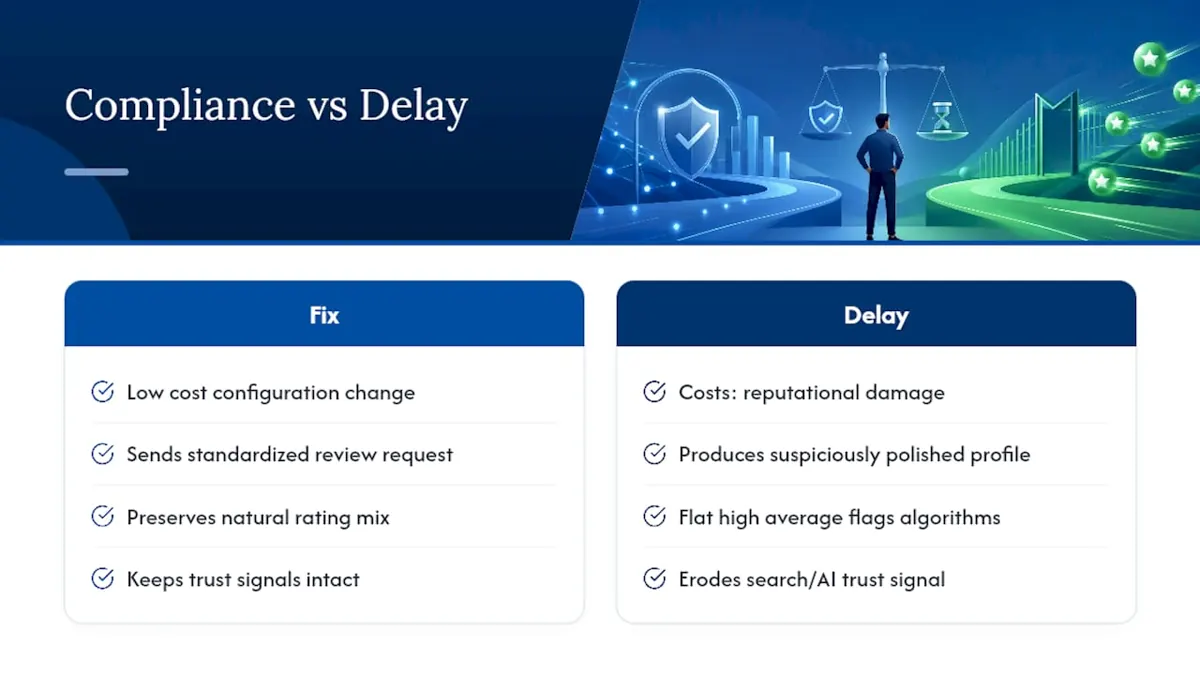
Search engines and AI answer engines increasingly treat that texture as a trust marker. A business with 400 reviews and a suspiciously flat 4.9 average reads differently to a pattern-matching system than one with a believable mix of scores and an obvious pattern of responding to the negative ones. Gating doesn't just risk enforcement, it quietly damages the exact signal businesses are trying to protect.
The businesses that come out ahead treat negative reviews as inputs, not liabilities. They respond publicly, fix the underlying problem, and let the next round of reviews reflect the fix. That's slower than curating your way to a clean profile. It's also the only version of "good reviews" that holds up when a platform, a regulator, or an AI model actually checks the math.
This article is general information, not a substitute for advice from a qualified lawyer. Consult a qualified legal professional about your own circumstances before acting on anything here.